Services / Procurement maturity assessment
Procurement maturity assessment
Replace intuition with evidence.
A scored, evidence-based view of where your procurement function sits across the 16 dimensions that matter, and a prioritised roadmap to move it forward.
Theories do not unlock budget
Most procurement leaders have a reasonable sense of where their function is strong and where it falls short. That sense rarely survives a steering committee, and it does not show whether a gap is structural or simply the result of two key people leaving in the same quarter.
A procurement maturity assessment is a structured evaluation of your function scored against a defined maturity model, from transactional purchasing through to procurement as a strategic business partner. It turns a conversation about impressions into one about investment priorities.
What you receive
- A scored baseline of where your function sits today
- A comparison with comparable organisations, where data is available
- A prioritised roadmap for improvement, with clear ownership
Governance redesign, a capability programme, a technology investment or an operating model change can then be argued on evidence.
Sixteen dimensions in four quadrants
The assessment looks well beyond price. It evaluates how procurement is governed, led, enabled and integrated across the organisation.
The result is a profile, not a single score. Each of the 16 dimensions is scored on its own, so the wheel shows at a glance where a function is advanced and where it lags. Most functions are strong in some dimensions and behind in others, and the gaps between dimensions say more than the overall level.
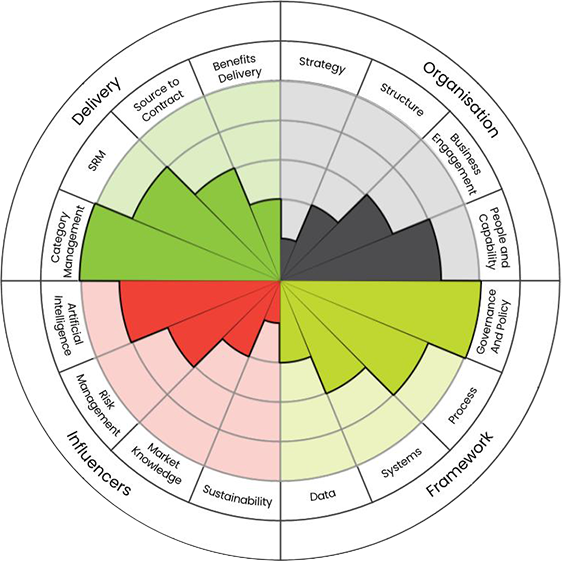
Can the function execute?
- Supplier relationship management
- Are key suppliers managed for performance and joint value, or contract to contract?
- Category management
- Does market intelligence shape the approach, or does every category get a tender?
- Source to contract
- How disciplined and consistent is sourcing across category types and contract values?
- Benefits delivery
- Can committed savings and value be tracked and proven in a way finance accepts?
Is procurement set up to succeed?
- Strategy
- Is there a procurement strategy connected to the business plan?
- Structure
- Where does procurement sit, and how do central and business-unit teams work together?
- Business engagement
- Is procurement involved early, or after specifications are locked?
- People and capability
- Does the team have the skills for the level the function is aiming at?
The infrastructure everything runs on
- Governance and policy
- Is the mandate clear, and are delegations right for the scale of the organisation?
- Process
- Are processes standardised and followed, or does each business unit run its own?
- Systems
- Is the technology fit for purpose, and is it actually used?
- Data
- Is spend data consolidated and reliable enough to manage and compare?
What separates good functions from great ones
- Risk management
- Is supply risk mapped across critical categories and suppliers, or handled as it arrives?
- Market knowledge
- Does real market intelligence inform sourcing strategy?
- Sustainability
- Are ESG requirements built into sourcing decisions?
- Artificial intelligence
- Where can automation add value now, and where must the foundations come first?
The five stages of procurement maturity
- 1
Basic
Procurement is administrative. Little coordination across business units, spend data scattered, suppliers chosen by familiarity.
- 2
Growing
A policy exists but compliance is inconsistent. Strategic sourcing happens in pockets; most spend is still managed reactively.
- 3
Progressive
A strategy connected to the business plan, category management for major spend, suppliers actively managed. Where most large organisations sit.
- 4
Established
Procurement is integrated with finance, operations, risk and legal. Data drives decisions and stakeholders come to procurement early.
- 5
Best in class
Procurement shapes business strategy, with advanced analytics and genuine supplier partnerships. Few organisations sustain this across every dimension.
Most organisations are neither Basic nor Best in class. They are Progressive in three dimensions and Growing in five, and that uneven profile is where the insight sits.
Assess, prioritise, roadmap for change
The emphasis is on a roadmap you can act on, not a report that describes problems without sequencing solutions.
- 01
Assess
Build the evidence base: stakeholder workshops, a structured questionnaire for the procurement team and its internal customers, document review and spend data analysis. The questionnaire also surfaces the gap between how procurement sees itself and how the business sees it.
You leave withA scored, evidence-based baseline across all 16 dimensions.
- 02
Prioritise
Map the findings against the maturity model, score each dimension on evidence rather than aspiration, identify the gaps and compare with comparable organisations where data is available.
You leave withA maturity profile showing where the function is strong, where it lags and which gaps matter most.
- 03
Roadmap for change
Rank initiatives by impact, effort, risk and cost, test their dependencies and sequence them into a realistic improvement plan.
You leave withA prioritised roadmap with clear ownership that a steering committee can decide on.
What separates functions that improve
The assessment is the easy part. The most common failure is treating it as a one-off project rather than the start of a programme.
Executive sponsorship
The roadmap needs a sponsor at executive level who will hold the organisation to it. Without one, procurement improvement competes with every other priority, and usually loses.
Realistic sequencing
Pick two or three high-impact initiatives for the first 12 months, deliver visible results, and use that momentum to fund the next phase.
Regular reassessment
Reassess every two to three years, or after significant organisational change, measured against the original baseline.
From findings to action
Where the assessment points to people and capability, SkillsGAP Analysis maps individual and team capability against a defined competency framework, and capability development closes the gaps. Where it points to data, procurement analytics builds a reliable view of spend.
Every assessment includes an AI readiness lens: where automation will add value at your current maturity, and where it would automate an inconsistency faster. AI in procurement takes that further.
Questions about maturity assessments
How is a maturity assessment different from a procurement audit?
An audit checks compliance: whether the policy was followed and the approvals happened. A maturity assessment asks whether the policy, approval framework and processes are fit for the organisation you are now. An audit finds fault; a diagnostic finds leverage.
Why use an external assessor?
Internal assessments tend to score the function at the level it is working towards rather than where it is. An external assessor brings objectivity, and has seen enough organisations to know what each stage looks like in practice.
Do we need to assess the whole procurement function?
Not necessarily. An enterprise-wide assessment gives the cross-organisational view a federated model needs. A narrower one, of a business unit or region, is faster and useful for targeted improvement, but will not show whether the patterns are local or systemic.
How often should we reassess?
Every two to three years, or whenever a significant change to the organisation, its market or the procurement team makes the original baseline out of date.
Know where you stand
Tell us about your procurement function, what is prompting the question and who needs the answer. We will recommend the right scope for an assessment.