

Tail spend has always been the procurement leader’s headache.
The economics don’t work: thousands of low-value purchases, scattered across suppliers and channels, rarely worth a category manager’s time-yet collectively large enough to hurt savings, compliance, and risk posture.
For years we’ve tried to solve tail spend with the usual playbook: catalogues, buying channels, policy reminders, P2P controls, and periodic spend analysis.
Those moves help-but they plateau.
The long tail keeps regenerating because the underlying problem isn’t intent. It’s scale.
That’s why AI agents are showing up as a genuinely useful tool in tail spend: they’re built for high-volume, repetitive, data-heavy work that humans are structurally set up to ignore.
And the research (plus early case evidence) is clear enough to treat this as more than hype: AI-driven classification and analytics repeatedly surface double-digit improvement opportunities in under-managed spend, and automation consistently compresses cycle times when embedded into workflows.
Let’s make this practical: what does “agents in tail spend” actually mean, where do they create value, and how do you adopt them without creating new risk?
First: what “AI agents” means (and what it doesn’t)
If you’ve sat through a few vendor demos, “agent” can mean anything from a chat window to a fully autonomous system negotiating contracts. For tail spend, the useful definition is much simpler:
An AI agent is a bounded, goal-driven workflow that can take actions within guardrails-not just analyze data, and not just answer questions.
So, in procurement terms, an agent might:
- classify a transaction and learn from corrections,
- detect a price variance pattern and open an investigation queue,
- guide a user to the right buying channel at the moment of demand,
- pre-screen a supplier using defined risk/ESG checks and route exceptions to humans.
This is not “hands-off buying.”
In fact, the strongest operating model is explicitly hybrid: agents handle the scale work; humans set the rules, approve exceptions, and own supplier and policy outcomes.
That hybrid approach is consistently recommended in the literature on procurement AI adoption and supply chain AI implementation, especially given data quality and explainability constraints.
Why tail spend is a perfect (and safe) starting point
Tail spend is frustrating because it’s simultaneously:
That combination creates a vacuum.
Procurement can’t staff it.
The business routes around it.
Finance sees the leakage later.
Risk teams discover suppliers only after something goes wrong.
AI agents fit because procurement tail spend is:
- data-heavy (POs, invoices, P-cards, free-text descriptions),
- repetitive (the same kinds of small decisions over and over),
- pattern-rich (duplicate suppliers, price variance, off-contract buying),
- under-managed (so the “low hanging fruit” stays low).
The win isn’t that agents do something magical. It’s that they do the boring work continuously-at the scale tail spend demands.
The tail-spend value stack: where agents actually pay for themselves
If you’re thinking about adoption, don’t start with “autonomous buying.” Start with a simple progression:
1) Data foundation and automated classification
If tail spend is your blind spot, classification is your eyesight.
Most tail spend programs fail quietly here. The data is messy. Descriptions are unstructured. Suppliers are duplicated. Taxonomies vary by ERP, region, or business unit. And the long tail is exactly where classification quality is worst.
This is where the strongest evidence exists: machine learning models can replicate expert classification decisions on messy procurement text and, in doing so, uncover material savings opportunities that were invisible under poor categorization. A frequently cited example is an AI model that improved categorization and surfaced projected annual savings of £16–22 million in one firm by revealing optimization opportunities embedded in fragmented spend (Li et al., 2025).
What a classification agent does in practice:
- ingests POs, invoices, and card feeds,
- normalizes supplier names and builds “supplier families,”
- applies category tagging even when descriptions are vague,
- flags uncertain classifications for human review,
- learns from corrections to improve over time.
CPO takeaway: classification isn’t clerical work anymore. It’s a compounding asset. Every improvement boosts the ROI of analytics, compliance, and sourcing.
2) Always-on tail analytics and opportunity detection
Once you can see tail spend clearly, the next move is to stop running “annual tail spend projects” and start running continuous detection.
Opportunity-mining agents can scan for:
- maverick buying and off-contract spend,
- duplicate suppliers,
- price variance across business units,
- missed rebates and contract leakage,
- bundling and aggregation opportunities.
This matters because the long tail is where your organization leaks value in lots of small ways. A one-time cleanse helps. But tail spend regenerates. An always-on agent keeps up.
The broader supply chain and procurement AI literature repeatedly reports cost and lead time improvements from analytics-driven automation, while also noting that the barriers are usually integration, data quality, and skills—meaning you want early wins that are operationally realistic.
CPO takeaway: treat tail spend like fraud detection, not a quarterly report. The point is continuous monitoring, not perfect insight.
3) Guided buying and policy-compliant automation
This is where tail spend control becomes real.
Guided buying is basically “procurement influence at the moment of demand.” Instead of sending policy PDFs and hoping people comply, a guided buying agent does the practical thing:
- it recommends the preferred channel/supplier for the user’s request,
- it enforces thresholds and approval logic contextually,
- it nudges before it blocks,
- it reduces cycle time by routing correctly the first time.
Think of it as policy enforcement without becoming the “procurement police.”
This aligns with what we already learned from RPA and digitization efforts in procurement: automation can relieve teams, improve efficiency, and change how work gets done—but adoption and organizational design matter as much as the tech (Flechsig et al., 2021; Viale et al., 2020). Agents simply push this forward by making the experience more adaptive and less brittle than rule-only automation.
CPO takeaway: the best compliance mechanism is not control-it’s making the right path the easy path.
4) Supplier scouting and risk screening for the tail
Tail spend is also where supplier sprawl and unmanaged risk live.
In many organizations, you discover tail suppliers after they’ve already been used—sometimes at the worst possible moment (a disruption, a safety incident, a sanctions issue, an ESG problem).
Supplier-scouting agents can help by:
- discovering potential suppliers (including SMEs) using semantic search,
- gathering basic supplier information quickly,
- pre-screening against defined risk, ESG, and compliance criteria,
- routing exceptions to humans.
The point is not to “automate supplier approval.” It’s to speed up discovery and screening, and to ensure the long tail isn’t a governance-free zone.
CPO takeaway: you’re not just buying pens and printers in the tail. You’re accumulating supplier exposure.
The operating model: where humans stay in control
Here’s the trap: it’s easy to talk about agents as “automation.” But CPOs don’t run automation programs-they run accountability systems.
A practical, safe model looks like this:
Procurement AI Agents do
- classification and normalization,
- detection and recommendations,
- guided buying prompts and routing,
- pre-screening and documentation collection.
Humans do
- policy design and threshold setting,
- exception handling and approvals,
- sourcing and negotiation where it’s worth doing,
- supplier relationship management and performance governance.
Everyone gets
- auditability (what was recommended, what was chosen, why),
- measurable outcomes (compliance, cycle time, savings),
- explicit decision rights.
This “hybrid” approach is exactly what the research and case evidence tends to support: AI can deliver significant improvements, but adoption depends on readiness, explainability, and governance design.
Value expectations: how to talk about ROI without hype
1. Hard savings
- reduced leakage and off-contract spend,
- consolidation from supplier duplication,
- better price consistency across units.
2. Process cost reduction
- fewer touches per transaction,
- faster cycle times,
- lower procurement workload on repetitive tasks.
3. Risk and compliance value
- fewer unmanaged suppliers,
- better policy adherence,
- faster detection of anomalies.
The strongest single anchor in your current evidence set is classification-driven savings (Li et al., 2025). Broader studies and frameworks point to cost and efficiency gains across procurement and supply chain processes when AI is implemented effectively, while also warning that results depend heavily on data, integration, and organizational maturity (Culot et al., 2024).
So, the honest expectation is:
You should expect meaningful improvement where tail spend is currently opaque and leaky—especially in organizations where procurement controls aren’t embedded into day-to-day buying behaviour.
But you shouldn’t expect a universal percentage without looking at your baseline data quality and compliance dynamics.
A low-regret implementation path (what I’d do first)
If you want traction in 90–120 days without triggering a governance crisis, sequence matters.
Phase 1: classification first (pick one spend stream)
Start with one of:
- P-card spend,
- spot buys/one-time vendors,
- a single long-tail category cluster (e.g., MRO, professional services micro-spend).
Your goal is not “perfect taxonomy.” It’s trustworthy visibility.
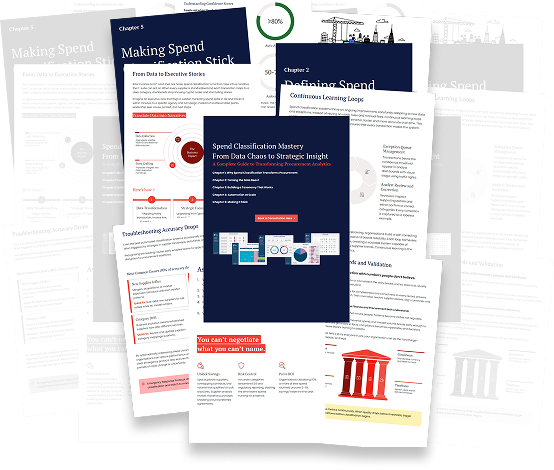
Spend Categorisation eBook
Don’t Just Track Spending; Transform it.
This free e-book shows how to turn messy data into clear, decision-ready insights.
It’s written for professionals who want to understand their spend better, make confident sourcing decisions, and show measurable value to the business.
Get the eBook >
Phase 2: turn on continuous opportunity detection
Use the now-cleaner data to run always-on detection:
- duplicate suppliers,
- top off-contract items,
- recurring micro-categories with consolidation potential.
Route results into a queue that procurement can action without drowning.
Phase 3: embed guided buying where demand happens
This is where value compounds:
- start with nudges and recommendations,
- then enforce where it’s politically and operationally safe,
- measure compliance and user effort (not just savings).
Phase 4: add supplier scouting + screening with clear guardrails
Only after the basics are working:
- define what the agent can auto-approve vs. what must escalate,
- define what sources/signals are acceptable,
- ensure audit trails are strong.
This sequencing matches what the procurement automation and AI adoption literature suggests: start where the data and process are most controllable, prove value, then expand.
The procurement leadership punchline
Tail spend used to be a tax on procurement: a constant drain of effort with limited strategic return.
AI agents change the shape of the problem. Not by replacing procurement judgment—but by making “control at scale” possible in a place where humans never had enough bandwidth to be consistently effective.
If you’re a CPO, the opportunity isn’t to chase autonomy.
It’s to design governed delegation:
- agents handle the volume,
- humans own the decisions that matter,
- and tail spend stops being a blind spot you apologize for.