

Effective procurement transformation relies on a robust measurement architecture established at the very beginning of the process, not as an afterthought. While organisations often rely solely on financial savings, these figures are frequently disputed by finance departments if they lack verified baselines or audit integrity. A comprehensive evaluation must also include leading indicators such as process efficiency, spend compliance, supplier risk, and stakeholder satisfaction.
The CFO is asking the same question they asked at the start of the transformation: what changed?
Eighteen months ago, the case for change was approved. There was a diagnosis, a roadmap, a business case, and a promise that investment would produce measurable value. The work began.
Now the function has numbers: savings from sourcing events, some improved cycle times, and supplier scorecards for major suppliers.
But the evidence is incomplete. Some savings are disputed because finance department never agreed on how they would be tracked. Cycle times look better, but there was no formal baseline. Supplier scorecards are new, so there is no trend.
This is not a reporting problem. It is a design problem.
Many procurement transformations build the measurement system too late, after the operating model is designed, sourcing waves are underway, and the CFO has started asking for proof. By then, the baseline is gone. The metrics available are often the ones that were easiest to collect, not the ones that best explain whether the transformation worked.
Measurement architecture must be designed at the start. It is what allows the CPO to answer the CFO’s question with evidence rather than assertion.
This article is the next step in the procurement transformation series.
The earlier articles looked at why transformations fail before they start and why roadmap sequencing matters as much as strategy. This article turns to the question that determines whether the transformation can ultimately be defended: how procurement proves what changed.
Savings are necessary, but are they enough?
Savings remain the most visible procurement metric because they are simple to understand.
A dollar figure can be reported, compared against the target, and presented to finance.
The problem is that they are often incomplete, poorly verified, or treated as the whole story.
Three things usually go wrong.
- First, savings lack audit integrity. A sourcing event may produce a negotiated reduction against a previous contract price, but that does not mean the saving has reached the bottom line. Unless finance agrees the method, validates the outcome, and links it to a budget reduction or avoided cost, the number remains a procurement claim rather than enterprise evidence.
- Second, savings capture only one dimension of value. Procurement also contributes through risk reduction, supply continuity, contract compliance, working capital improvement, supplier resilience, ESG data, and faster business enablement. None of this is visible in a simple savings tracker.
- Third, savings are lagging indicators. By the time the financial result appears, the opportunity to intervene may have passed. A transformation needs leading indicators that show whether the programme is working while there is still time to adjust.

The answer is not to abandon savings.
It is to place them within a broader measurement architecture that reflects how procurement value actually works.
The full transformation metric set
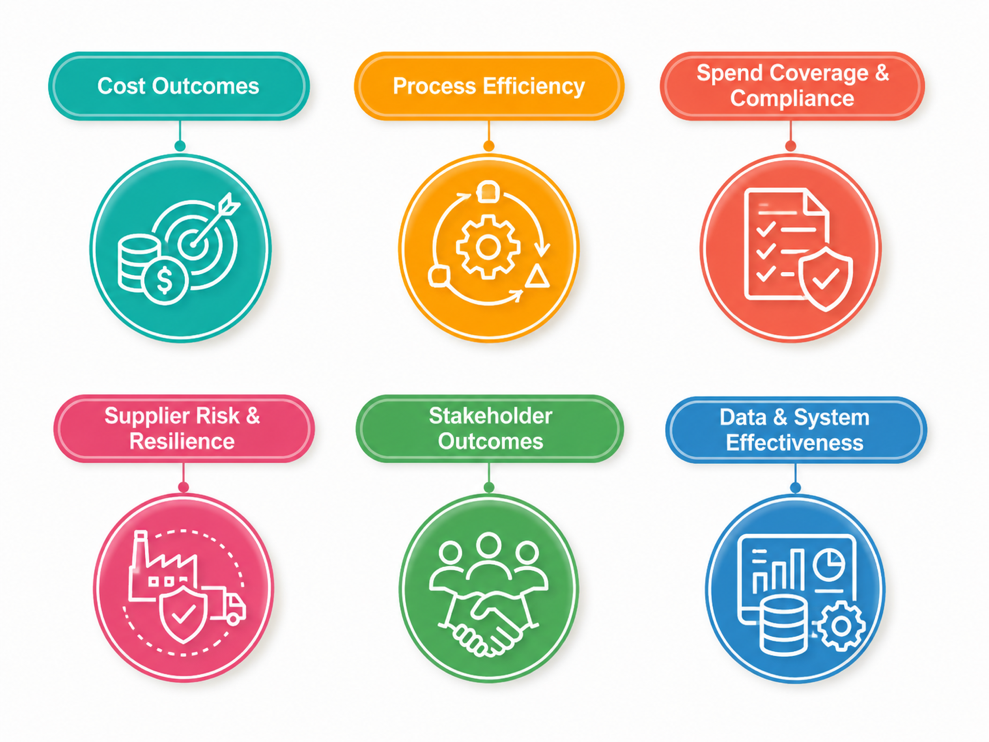
A credible procurement transformation should consider six categories of measurement. Not every category will be equally important in every organisation, but each should be considered deliberately.
1. Cost outcomes
Verified savings are the starting point. These should be finance-agreed, linked to budget or cost avoidance logic, and capable of being audited. Total cost of ownership also matters, especially where purchase price understates the real economics of a category. Payment terms performance should be tracked where working capital is part of the value case. In inflationary markets, savings against last year’s price can be misleading; value is better assessed against an index-adjusted market benchmark.
2. Process efficiency.
Cycle times are among the most useful leading indicators. Requisition-to-PO time, tender-to-contract time, and contract-to-delivery time show whether redesigned processes are working in practice. If the transformation includes technology investment, these metrics should improve early. They also reveal where process design, approval layers, or system adoption are slowing the organisation down.
3. Spend coverage and compliance.
Procurement must show how much addressable spend is under contract, how much spend flows through approved channels, and whether contract compliance holds after signing. These measures show whether the operating model has real reach. In federated organisations, they are especially important because procurement may influence spend without directly controlling it.
4. Supplier risk and resilience.
Supplier performance cannot be limited to delivery and quality. Critical supplier concentration, geographic exposure, cyber risk, continuity planning, ESG data quality, and modern slavery compliance are increasingly material. Since supply disruption became a board-level issue, procurement has been expected to provide evidence of resilience, not just commercial performance. That requires active supplier management, structured reviews, and reliable data.
5. Stakeholder outcomes.
Business unit satisfaction is not a vanity metric. It is an early warning system. If procurement improves its internal process but stakeholders remain frustrated, they will find ways to bypass it. The more important measure is whether procurement is being involved earlier in business decisions. Earlier engagement is a sign that the function is becoming more trusted and more strategic.
6. Data and system effectiveness.
This category has become essential. Procurement cannot measure what its systems and data cannot see. The function should track how much work flows through core systems rather than manual workarounds, how complete spend and contract data are, and where data gaps limit analytics, compliance monitoring, or supplier risk tracking. As AI-enabled sourcing and contract tools become more common, the quality of procurement data architecture directly determines what can be measured.
Together, these six categories give a more complete picture of transformation value: financial impact, operational efficiency, governance reach, supplier resilience, stakeholder trust, and data maturity.
Measurement is an upfront programme design decision
Measurement should not be added at the end of a transformation. It should shape the programme from the start.
The baseline must exist before anything changes.
The diagnostic phase should establish the current state across spend, process, governance, technology, capability, supplier management, and performance data. That current-state view is the “before.” Without it, the CPO cannot credibly show the “after.”
Benefits tracking must also be built into governance.
The transformation office should not only manage milestones and dependencies; it should track whether each initiative is producing the intended outcomes. Sprint reviews, quarterly steering reports, and annual programme evaluations should include benefits tracking as a standing item. This changes measurement from retrospective reporting into active management.
Finally, procurement reporting must connect to enterprise objectives.
Metrics that remain inside procurement are invisible to the people who determine its budget, authority, and role. The measurement architecture should make procurement performance visible in executive reporting alongside financial performance, supply chain risk, working capital, compliance, and operational resilience.
Too many procurement transformations measure the wrong things, at the wrong time, for the wrong audience.
When procurement metrics appear only in a separate procurement report, the function remains peripheral. When they appear in the board pack as part of enterprise performance, the function’s position has changed.
What a good procurement transformation measurement looks like
The organisations that measure transformation well have one thing in common: they decide what success looks like before implementation begins.
In a financial services procurement restructure, performance benchmarks were set before the first implementation wave. The organisation moved to a clearer category model, redesigned processes before adopting technology, and reviewed performance quarterly with the CFO’s involvement. The specific targets mattered less than the sequence: benchmark before building, then review before reporting.
McKinsey’s 2025 analysis of enterprise-wide transformations found that top performers built savings pipelines more than 60% larger than their headline targets, delivered at least 16% of the financial target in the first three months, and invested in capability building while executing. The measurement lesson is that leading indicators allowed these organisations to see where momentum was building and accelerate accordingly.
After year one: the measure that matters most
Transformation does not end when implementation milestones are complete. This is where many programmes lose value.
Categories that were consolidated begin to accumulate tail spend again. Supplier relationships that were actively managed drift back to passive contract compliance. Streamlined processes develop new workarounds. People move roles, priorities shift, and the operating model starts to decay.
This is normal. It is not proof that the transformation failed. It is proof that no operating model sustains itself without maintenance.
A mature procurement function needs scheduled category reviews, periodic reassessment of supplier risk, and regular benchmarking against comparable organisations. Benchmarking every two to three years is not just a validation exercise. It shows where performance has slipped, where peers have moved ahead, and where the next investment should go.
This is where Purchasing Index fits.
PI provides external benchmarking on procurement performance, costs, and capability using comparable organisations rather than generic industry surveys. For a function that has completed a transformation, it gives the CPO an evidence-based view of current position and future priorities.
For functions still in diagnostic or design, external benchmarks also help define what good should look like before the roadmap is built.
The CPO who controls the narrative
Return to the CFO’s question: what changed?
A CPO who built the measurement architecture at the start can answer clearly.
- Here is where we began.
- Here is the baseline.
- Here is what we planned to change, and why.
- Here is what changed.
- Here is what finance has verified.
- Here is what external benchmarks show.
- Here is where the next investment should go.
That changes the conversation from “prove it” to “where next.”
This is not a communication outcome. It is an evidence outcome.
A procurement function that has transformed is different from one that has completed a transformation programme. The first continues to improve. The second simply finishes. Measurement architecture is what makes ongoing transformation possible.
For organisations reviewing or building procurement measurement architecture, the three layers are clear: Purchasing Index provides external price and performance benchmarking, Skills Gap Analysis identifies capability gaps, and Comprara’s Procurement Maturity Assessment evaluates the function’s current operating maturity.
For a consultation – book a session here >
For CPOs still in diagnostic or design, the same principle applies earlier. Build the measurement system before the transformation starts, or there will be no evidence when the CFO asks for it.