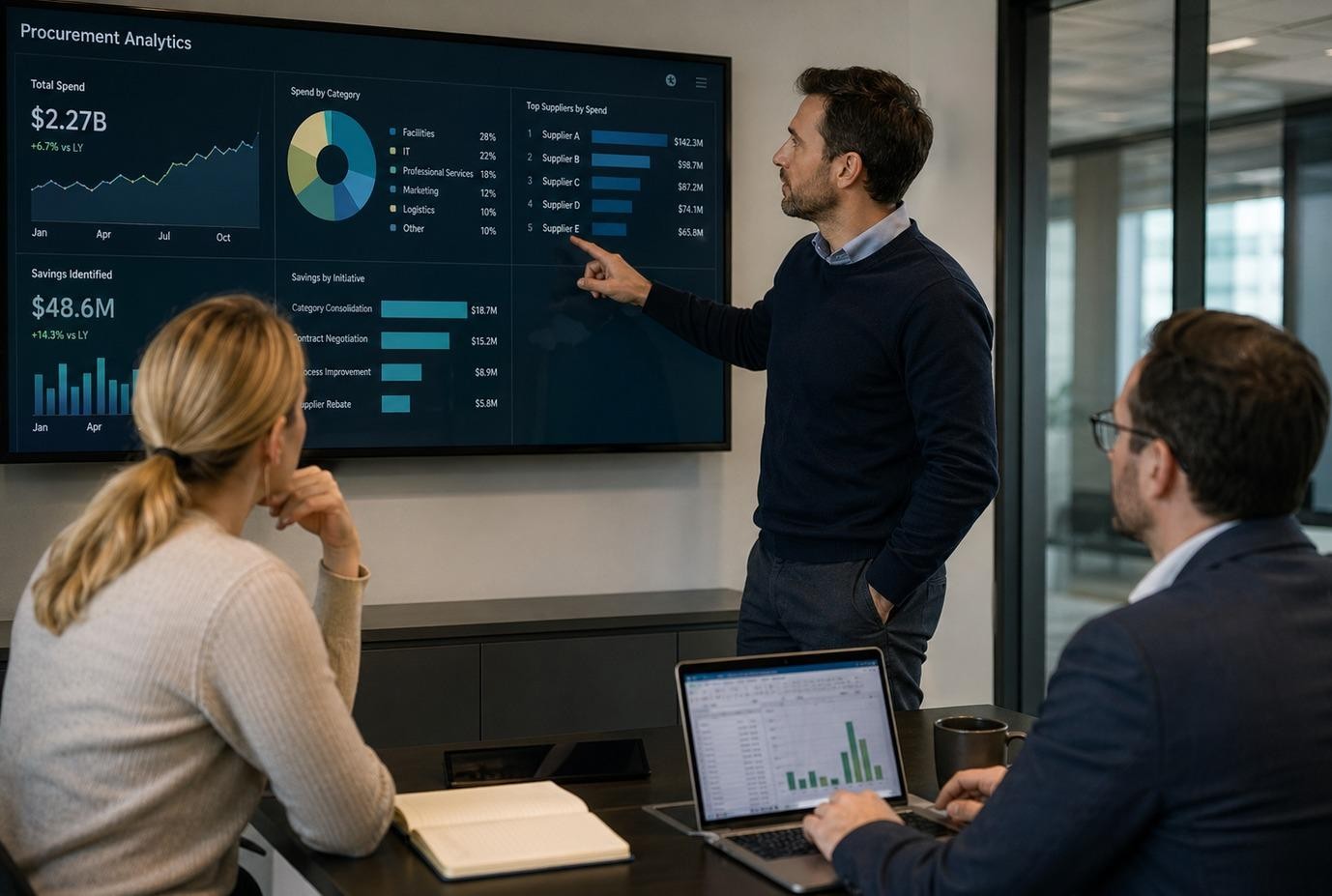
Many procurement transformation roadmaps are project plans wearing a different label.
They list initiatives. They assign owners. They set timelines and track completion.
What they do not do is explain the logic of why the initiatives sit in that order, what the sequencing depends on, or what needs to be true before the next phase can begin.
When something changes, a senior person leaves, a major contract renews early, or executive attention shifts to a different priority, the plan has no way to adapt because the underlying logic was never made explicit.
The plan still exists. It just stops being a useful guide to what to do next.
A real procurement transformation roadmap is a sequenced set of decisions about what to change, in what order, under what governance, based on a clear view of where the function is and where it needs to be. The initiatives matter. The sequence matters more.
This article explains how to build a roadmap that holds together when reality does not cooperate with the plan.
If the sequence cannot survive a change in people, priorities, or contract timing, it is not a roadmap. It is a task list.
Why procurement transformation roadmaps fail
A roadmap is built on a baseline. That is the precondition.
Without it, the design phase is operating on assumption. Article 1 in this series covered the failure modes that follow when transformation begins without a proper diagnostic. The point here is what the baseline enables once you have one.
Confirm the procurement operating model before building the roadmap
The roadmap should not be the first place these decisions are made. By the time an organisation is sequencing initiatives, the core operating model choices should already have been tested: where procurement leads, where the business retains control, how categories are governed, and what kind of commercial role the function is expected to play.
If that work has not been done, the roadmap is starting too late in the process. It may still produce a list of initiatives, but the list will be built on unresolved questions about authority, accountability, category ownership, and stakeholder commitment. Those questions do not disappear once the plan is approved. They come back during delivery, usually as delays, bypass behaviour, duplicated work, or savings that cannot be converted into recognised value.
For organisations that have already completed the diagnostic and operating model design, this section acts as a final check before the roadmap is built. For organisations that have not, it is the point at which advisory support is usually needed: not to produce more documentation, but to force the choices that make the roadmap executable.
The roadmap should sequence decisions already made. It should not hide decisions the organisation has avoided.
Check the centralisation model before sequencing initiatives
The first check is where the line sits between centralised, federated, and business-led procurement activity. There is no universally right answer. There is a right answer for each organisation, based on how spend flows, where category expertise lives, where risk concentrates, and what the business units will actually accept.
The design work maps spend concentration against category complexity and political reality, then draws the line deliberately rather than inheriting whatever accumulated over time. Strategic and high-value categories may need full category management
. Transactional spend may need streamlined self-service. Some categories may sit in between, with procurement leading the commercial strategy and the business retaining technical or operational decision rights.
The point is not to centralise for its own sake. The point is to make the authority model explicit before the roadmap starts assigning initiatives, owners, and benefits.
Confirm category architecture and decision rights
The second check is category architecture: which categories are led centrally, which are devolved, and which are collaborative. This is the governance decision that determines where procurement adds commercial value and where it functions as processing overhead.
The decision rights need to be documented explicitly, not just as an org chart, but as practical answers to delivery questions: who approves supplier selection, who signs off category strategy, who owns the supplier relationship after contract award, who carries the risk, and who confirms the benefit has landed. Ambiguity here is what produces bypass behaviour once delivery begins.
Test whether each category strategy is commercially defensible
The third check is the quality of the category strategy itself. A category strategy is not commercially strong because it has a savings target attached to it. It is strong because it explains the market structure, the supplier behaviours procurement is trying to change, the demand levers that sit with the business, the risks that finance and legal need to price, and the trade-offs stakeholders are being asked to accept.
A strategy that cannot answer those questions is unlikely to survive contact with the market. It may still generate sourcing activity, but activity is not the same as transformation.
Define what procurement is there to do
The final check is the purpose of the function. This sounds philosophical. It is operational. A function that exists to manage compliance has a different process architecture to one that exists to drive commercial outcomes. The two are not mutually exclusive, but the balance determines where resources go, what the team is measured on, and how stakeholders experience procurement when they need to buy something.
Name the role of procurement explicitly. Make sure it matches what the diagnostic showed the function is capable of delivering in the near term, alongside what it can build toward over the medium term.
These operating model decisions are the inputs to the roadmap. The initiative list comes after them. It does not replace them. Skipping this step is one of the most common reasons a transformation plan looks coherent on paper and produces incoherent results in execution.
Use diagnose, design and deliver as the roadmap architecture
The structure of a transformation programme is straightforward in principle and consistently mishandled in practice. Three phases, in this order, with no shortcuts.
Diagnose: create the evidence base for every decision
The baseline, the gap map, the capability picture. The point worth making is that diagnose is not a phase you complete and move on from. It produces the evidence that every subsequent decision is accountable to. If a design choice cannot be justified by reference to a diagnostic finding, it should be questioned. The diagnostic is the document the design phase keeps returning to, not the document that gets filed once the project plan is approved.
Design: turn operating model choices into executable work
This is where the operating model decisions become concrete. Category strategies are built or rebuilt. Processes are mapped and redesigned in enough detail that the person doing the work knows exactly what happens at each step. Procurement Governance is documented with actual decision rights, not aspirational principles. Technology requirements are specified based on what the redesigned processes need, rather than what a sales presentation promised. The initiative roadmap is built here, as an output of design, not as an input to it. Many organisations build the initiative list first and reverse-engineer the design to fit it. That is the wrong order, and it is responsible for a significant share of transformation underperformance.
Deliver: sequence quick wins and foundations together
Initiatives are executed in waves, not all at once. The first wave combines two distinct types of work: visible quick wins that show progress, and foundational work that everything subsequent depends on. The quick wins buy political capital. The foundational work buys execution capacity. A first wave that consists only of quick wins runs out of runway before the structural changes land. A first wave that consists only of foundational work loses executive attention before the deeper benefits emerge. Both are needed.
McKinsey research on procurement-led transformation found that leaders who met or exceeded their targets generated at least 16% of total savings in the first three months. That figure only matters if the benefit type is explicit.
A roadmap should distinguish contracted savings, run-rate savings, cash release, avoided cost, and P&L impact, and it should state which evidence is required before each benefit is reported.
The point is not speed for its own sake. The point is to identify benefits that can be validated early, recognised properly, and used to keep executive attention on the programme.
Early savings are only useful if Finance can recognise them and the business can see where they landed.
A concrete example of the distinction. Consolidating a tail-spend category from four suppliers into one contract: quick win, visible savings, manageable effort, three-month delivery. Fixing the data governance architecture that means spend data cannot be reported consistently across business units: foundational, invisible to most stakeholders, eighteen-month effort, and absolutely required before any spend analytics investment makes sense. Both initiatives belong on the roadmap. They do not compete for prioritisation. They sequence.
Prioritise initiatives with the opportunity map, contract calendar and savings pipeline
The opportunity map is the tool that makes prioritisation honest. It gives a structured view of every potential initiative, mapped against estimated value and estimated effort, with a delivery timeline driven by contract expiration calendars and resource capacity. It is not driven by executive preference or by which category manager is most vocal. The map exists specifically to take the prioritisation conversation out of the room and put it on the page.
Two points that many roadmap discussions skip.
1. Use contract renewal dates as sequencing constraints
The contract calendar is one of the most underused prioritisation tools in procurement. If a $40 million contract renews in seven months, that category goes to the top of the list regardless of where it sits on the effort-value matrix. The timing is a constraint rather than a preference. If the team is not ready to negotiate when the contract expires, the organisation accepts whatever the incumbent offers, or exits a relationship without a replacement strategy. Neither is a good outcome. The contract calendar sets the sequencing constraints. The opportunity map allocates resources within those constraints. Finance also has a legitimate sequencing lens here: contracts tied to working capital, volatility, balance-sheet exposure, or risk-adjusted cost may move ahead of cleaner sourcing events with easier optics.
2. Build a savings pipeline above the target
Build the savings pipeline at sixty per cent above the stated target. This is calibration rather than sandbagging. The McKinsey research is consistent: transformations that pipeline exactly the savings figure they announced routinely fail to deliver it because some initiatives slip, some market conditions shift, and some negotiations land below the modelled number. The organisations that consistently hit announced targets had materially more in the pipeline than the headline figure required. A function announcing a $30 million savings target should be working a pipeline closer to $48 million. The discipline of building that pipeline forces the prioritisation conversation to surface marginal initiatives that would otherwise be left off the plan, and some of those marginal initiatives are the ones that carry the programme when the major plays underdeliver.
Give the transformation office financial controls, not just reporting duties
Many transformation programmes have a steering committee. Fewer have a transformation office.
The two are different objects, and the difference matters.
The steering committee exists to make decisions. The transformation office exists to make sure the decisions get implemented: interdependencies between workstreams are managed, benefits are tracked in real time rather than reported retrospectively, risks are surfaced early enough to be addressed, and when something goes wrong, which it will, someone is accountable for identifying it and adapting. Without a transformation office, a procurement transformation is a collection of parallel workstreams that make sense individually and do not add up to a coherent programme.
The transformation office also needs financial control built into its operating rhythm. Finance should sign off the baseline, the benefit categories, and the recognition rules. Procurement should own the delivery evidence. The steering committee should arbitrate challenged claims. No benefit should be counted twice across price reduction, demand reduction, cost avoidance, working-capital improvement, or risk reduction. Without this discipline, the transformation office becomes another reporting layer with a better dashboard.
The test is simple: who signs off the baseline, who validates the saving, and who stops the same benefit being counted twice?
The transformation office is also the body that holds the design methodology when individual workstream leads start making decisions that drift from the operating model the diagnostic supported.
Without that holding function, design decisions made in week 30 stop reflecting the logic that justified the programme in week 1, and by month 18 the organisation has implemented something subtly different to what was approved.
In practice, the transformation office handles four things the steering committee cannot.
- It runs the benefits tracking, not the annual report on whether savings landed, but the monthly view of whether each initiative is tracking against its modelled value, with named owners and current status.
- It manages the interdependencies between workstreams: when the category strategy work depends on a data taxonomy that the analytics workstream is still building, the transformation office is the body that surfaces the dependency before it becomes a blocker.
- It owns the risk register at programme level rather than initiative level, which is where the cross-cutting risks actually sit.
- It maintains the line of sight between the daily activity and the original design intent. That last function is the one that is hardest to staff and most consistently neglected, and it is also the one that determines whether the programme ends up where the diagnostic said it should.
Use category boards to win business commitment
Category boards sit alongside the transformation office.
These are cross-functional bodies with representation from finance, operations, IT, and legal, owning the major category strategies.
Their existence is what turns category management from procurement telling the business what it is buying into procurement leading a commercial conversation that includes the people whose budgets are affected.
They work when business units have real decision rights rather than attendance rights, and when procurement is willing to put trade-offs on the table: service levels, supplier risk, local autonomy, transition cost, and timing. That is how procurement earns commitment when the roadmap threatens entrenched supplier relationships or business-unit control. That shift in posture is the difference between category strategies that get implemented and category strategies that get ignored.
The governance architecture connects directly to one of the failure modes identified in Article 1: the tendency to treat transformation as a project rather than a programme.
A project has a defined end.
A programme has a governance structure that keeps holding the work after the project plan has been executed.
The transformation office is what makes the second possible.
Build procurement capability beyond training
A transformation that designs new structure without building the capability to run it is building something the current team cannot operate.
The new operating model requires new skills. If those skills are not developed in parallel with the model being designed, there is a lag, frequently measured in years, between when the structure goes live and when the team can actually use it.
The same McKinsey research found that teams with proactive capability development completed more than half of procurement projects on time or early, against one-third for teams without dedicated upskilling.
The gap is not a soft benefit.
It is an execution risk that compounds across the life of the programme. Teams without the skills to run category management cannot deliver the category savings the roadmap promises. The initiative sits on the plan. The result does not follow.
The practical implication is that capability has to be built into the roadmap from the start. The skills map produced through structured capability assessment, such as Skills Gap Analysis for this layer of the diagnostic, generates the curriculum.
The curriculum is then sequenced against the delivery waves: the category managers who will run the first-wave sourcing events get trained before those events begin, not afterwards. The negotiation capability needed for the second-wave high-value contracts is built in the months leading up to those contracts, not in response to a missed savings target.
Procurement training is only one lever.
The capability plan also needs role redesign, revised incentives, coaching cadence, selective hiring, performance management, and direct action where a key role-holder cannot operate the new model.
Otherwise the organisation has a trained team on paper and the same delivery constraints in practice.
A capability plan that only trains people leaves the operating model underpowered.
This is where the Academy of Procurement sits in the transformation architecture. It is the delivery mechanism for the skills the operating model requires.
A category management programme that builds the team's analytical, commercial, and stakeholder engagement capability before they are asked to run a complex category review. A negotiation programme that develops the team's ability to engage suppliers on value rather than only on price, before the contracts that depend on that capability come up for renewal. Sequenced into the roadmap, not bolted onto the side of it.
The connection between capability development and execution is the part of transformation design that gets the least attention and produces the most consequential gap between plan and delivery.
A roadmap that does not build the team it requires is a roadmap that fails on schedule.
What a real procurement transformation roadmap looks like in execution
A transformation roadmap built on a proper diagnostic, through disciplined design, with capability development running in parallel and governance structures that hold the programme together is a different object to a project plan with a transformation label on it.
The distinction shows up in execution. It shows up in whether benefits land in the budget or only in the report. It shows up in whether the team a year in is running the new model or still asking what the new model is supposed to mean. And it shows up in whether the CPO, eighteen months into the programme, is explaining what procurement has done, or being asked what procurement should do next.
The CPO building this kind of roadmap is making a series of decisions that most procurement transformation programmes never explicitly make.
- Which decisions live with the centre and which with the divisions. Which initiatives sequence ahead of which others, and why.
- Which capabilities need to be built in which quarter, and against which delivery wave. Which governance bodies own which outcomes.
- Which benefits finance will recognise, which category strategies the business will actually back, and which roles need to change before the model can work.
Each decision is defensible because the diagnostic supports it, the design phase pressure-tested it, and the transformation office tracks it.
For CPOs designing a procurement transformation roadmap, Comprara's strategic advisory practice can support the design methodology while the internal team manages the politics. Book a consultation here >
The next question, and the subject of the final article in this series, is how to know whether the roadmap is actually working. The measurement architecture that distinguishes a transformation delivering value from a transformation reporting activity is a separate problem, and one that most programmes underbuild.