

TLDR: Most procurement transformations fail not because the goal was wrong, but because the order of operations was. Technology is bought before processes are fixed. Operating models are redesigned without a proper baseline. Savings targets are set before anyone checks whether the team can execute them. The common cause is a diagnostic failure, designing the future state before understanding the current one.
Why Most Procurement Transformation Mandates Arrive Without a Workable Starting Point
You have been handed a transformation mandate. The trigger does not matter much, cost pressure from the CFO, a new CEO who wants procurement on the agenda, a board that has decided the function is underperforming, or a failed contract that made the wrong kind of headlines. Whatever it was, the outcome is the same: a clear directive and an unclear path.
The function already has something that looks like a strategy.
There is probably a technology review underway, a list of improvement initiatives someone compiled last quarter, and a savings target that was announced before anyone modelled whether it was achievable. The gap between what has been committed to and what will actually change is wide. It is also narrowing, in the wrong direction.
This is not a failure of ambition. It is a failure of sequencing.
The pattern holds across industries, organisation types, and mandate sizes. The right destination, reached in the wrong order. The rest of this article names exactly how that happens, and why it keeps happening to functions that are otherwise well-led.
What Triggers a Procurement Transformation, and Why the First Response Is Usually Wrong
Cost-reduction mandates are the most common driver.
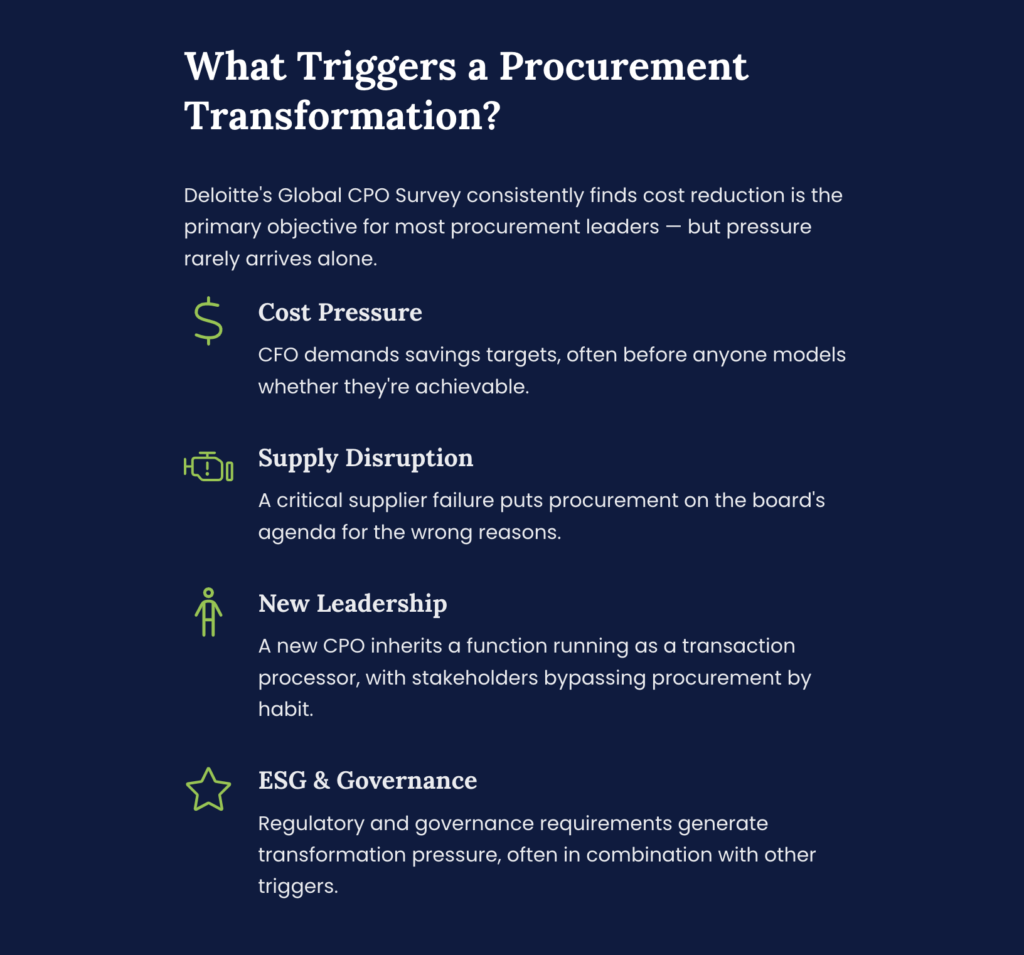
Deloitte’s Global Chief Procurement Officer Survey consistently finds that delivering cost reduction is the primary objective for the majority of procurement leaders. But cost pressure rarely arrives alone. Supply disruption, ESG governance requirements, digital transformation agendas, machinery-of-government restructures, and new leadership all generate transformation pressure, often in combination.
A new CPO inherits a function that has been running as a transaction processing operation for years. Stakeholders bypass procurement as a matter of habit. The CFO is asking questions the function cannot answer. A supplier has just failed to deliver on a critical contract, and suddenly procurement is on the board’s agenda for the wrong reasons. Each of these is a legitimate trigger. None of them is the problem.
The problem is what these triggers tend to produce as a first move.
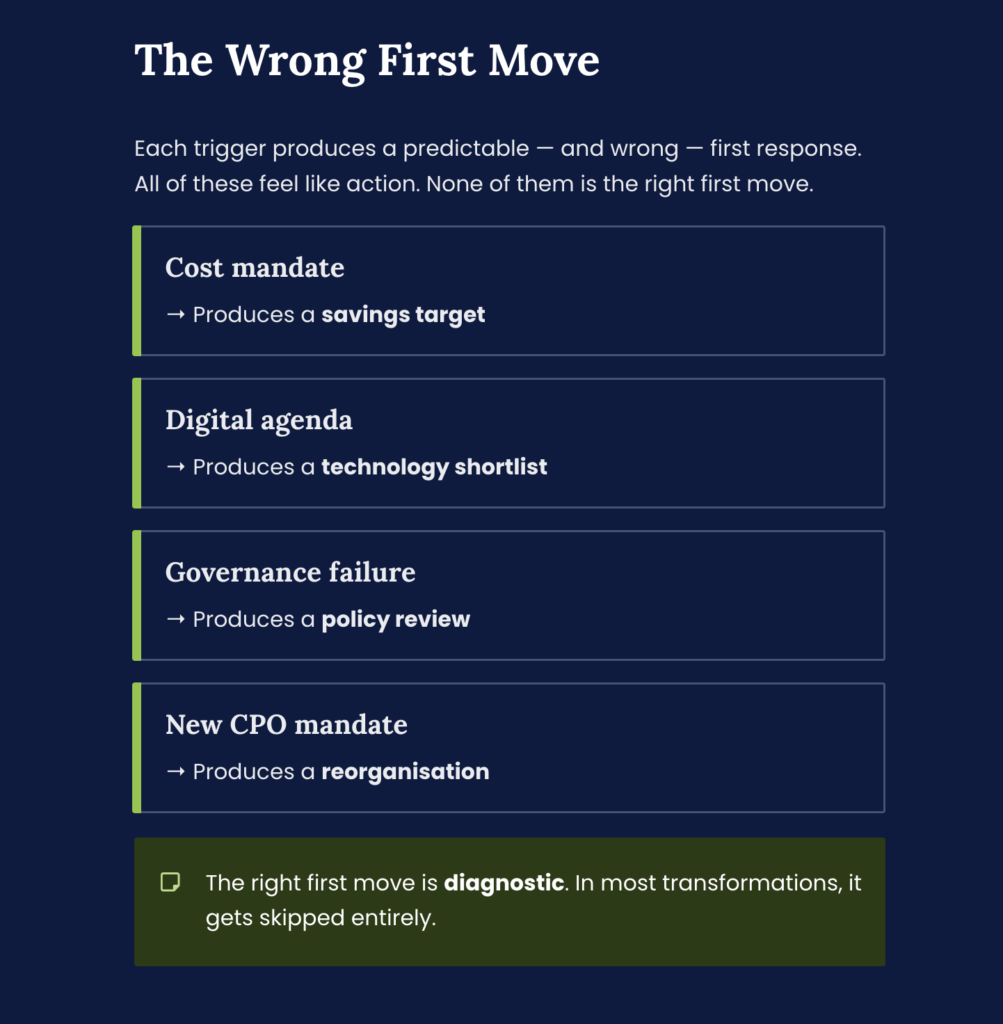
A cost-reduction mandate produces a savings target. A digital agenda produces a technology shortlist. A governance failure produces a policy review. A new CPO with a mandate to lift the function’s profile produces a reorganisation. All of these feel like action. None of them is the right first move.
The right first move is diagnostic. And in most transformations, it gets skipped entirely.
Five Procurement Transformation Failure Modes, and Why Each Feels Reasonable at the Time
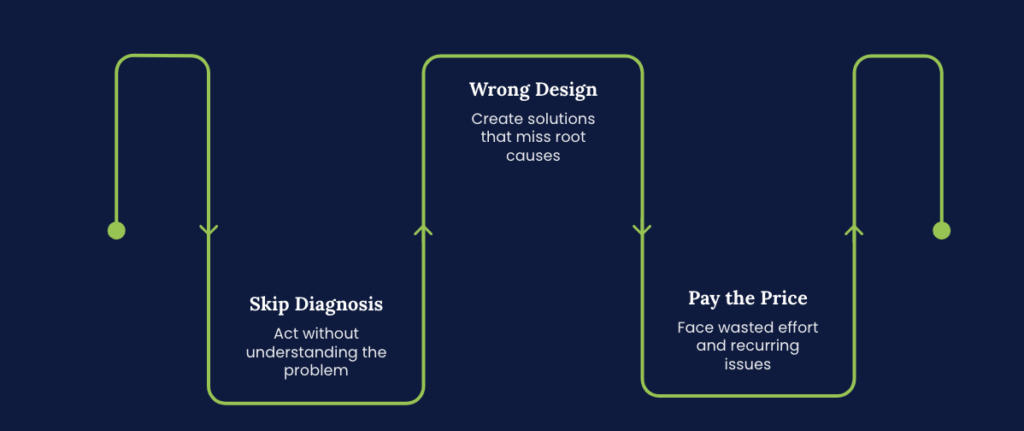
There is no single failure mode. There are five, each with its own internal logic that makes it feel reasonable at the time.
1. Technology Before Process
The organisation selects a source-to-pay platform. The business case is compelling: better data, faster cycle times, end-to-end visibility. Implementation begins. Eighteen months later, adoption is poor, cycle times have not improved, and the platform is being used for a fraction of its intended purpose.
The platform worked as designed. The approval workflows it was supposed to run were broken before implementation started, and automating a broken process entrenches it. Deloitte’s research on procurement operating models has consistently found that organisations which try to layer technology over process problems simply embed those problems at speed and scale. The sequencing should have been: fix the underlying workflow, define the process it should follow, then deploy the technology to run that process efficiently. Almost nobody does it in that order.
2. Operating Model Redesign Without Diagnosis
A consulting firm is commissioned to redesign the procurement operating model. Interviews are conducted. Benchmarks are reviewed. A report is delivered, ninety slides, a new structure, a recommended governance framework, a proposed centre-of-excellence model.
The report is implemented. The new structure goes live. Twelve months later, the function is performing approximately as it was before, with a different org chart.
What the report could not account for, because nobody had properly mapped it, was how spend actually flows through the organisation, which categories carry strategic value versus which are transactional, what the team is genuinely capable of executing, and which business units will engage with a redesigned governance model versus which will simply continue to bypass it.
The operating model was designed for a function that did not exist. The actual function, with its actual constraints and actual relationships, was never properly understood.
3. Savings Targets Without Execution Capacity
The CFO announces that procurement will deliver $50 million in savings over two years.
The number is credible on paper, it represents a reasonable percentage of addressable spend. It is published in the annual report. The transformation is now associated with a number.
Nobody has assessed whether the category management capability exists to run the sourcing events required to find that saving.
Nobody has mapped whether the supplier relationships are in place to negotiate effectively.
Nobody has checked whether the process maturity is there to capture, track, and verify savings in a way the CFO will actually accept as landed.
The savings get claimed. Some of them land in the budget. Most do not. The following year, the same conversation restarts with a different number.
4. Change Management Treated as a Communications Plan
Townhalls are held. A transformation newsletter goes out monthly. The procurement vision is published on the intranet with a diagram showing what “future state” looks like. Business units are informed.
They continue to bypass procurement.
Because the governance framework has not changed.
The stage gates that projects move through have not been redesigned.
Procurement is still being engaged at the point of contract execution rather than at the point where scope and supplier decisions are made. The team’s commercial advisory capability, the thing that would make early involvement worthwhile, has not been developed.
Research on e-procurement implementation failures has found that insufficient change management has derailed more transformation programmes than any technical failure. But change management is not a communications plan. It is a redesign of how work gets done, who is involved, and at what point. That requires structural change, not newsletters.
5. Treating a Procurement Programme as a Collection of Projects
A transformation programme is launched. It has twelve initiatives. Each has a sponsor, a budget, a timeline, and a status that gets reported monthly. Some initiatives succeed. Some stall. Some are quietly redefined to become achievable. At the end of the programme, the function is better in some areas and unchanged in others. Nobody can construct a coherent before-and-after story because the initiatives were never connected to a shared view of where the function was going.
Three years later, the next CPO inherits the function and commissions another transformation.
The Root Cause: Designing a Procurement Transformation Before Diagnosing the Current State
These five failure modes look different on the surface.
The cause running through all of them is diagnostic: each involves designing or implementing a solution before the problem has been properly understood.
You cannot design the right operating model until you know where spend is concentrated, how it flows through the organisation, where the process bottlenecks sit, and what the team is genuinely capable of executing.
You cannot build the right capability programme until you have mapped the skill gaps across your people, not by category or seniority, but at the level of specific competencies. You cannot set a credible savings target until you know what is addressable, over what timeframe, using what level of resource and effort.
All of these require a proper current-state assessment before any design work begins.
Most transformations skip that assessment, either because the mandate is already defined and the solution feels obvious, or because the diagnostic work does not feel like visible progress.
A hospital does not design a treatment plan before running a diagnostic. A structural engineer does not propose a redesign without understanding the existing load-bearing elements. Procurement transformation is no different, except that it routinely skips the diagnostic step and goes straight to the intervention.
Research on procurement performance found that organisations which met or exceeded their transformation targets shared a specific characteristic: they set savings pipelines significantly larger than their headline targets (on average, 60% larger),
generated meaningful savings in the first few months to establish credibility, and invested in capability building in parallel with execution.
The distinguishing factor was calibration, they started with an accurate view of what was achievable, which requires knowing where you actually are before committing to where you are going.
The Right Sequence for Procurement Transformation: Diagnose, Design, Build
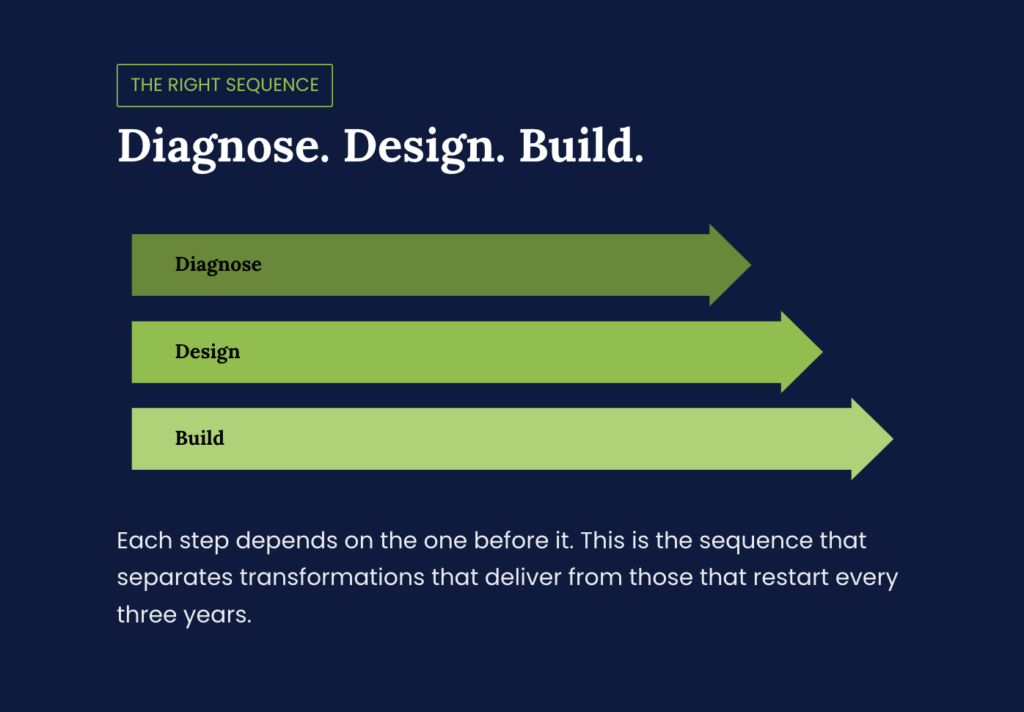
The rest of this series follows a specific sequence. Each step depends on the one before it.
1. Diagnose before you design.
Understand where the function is before deciding where it needs to go.
This means an external, benchmarked assessment of where the function sits across governance, capability, process maturity, and systems, not a spend analysis, not a technology review, not a self-assessment by the team that will be judged on the results.
2. Design before you build.
The operating model, governance framework, and category architecture need to be defined before initiatives are launched.
The transformation roadmap is an output of design work, not an input to it. Article 3 covers how to build a roadmap that reflects the diagnosis and sequences change in a way that is both ambitious and executable.
3. Build with measurement built in.
Benefits realisation is not a retrospective exercise.
The metrics, the tracking mechanisms, and the reporting architecture need to be designed alongside the transformation, not added at the end when the CFO asks what changed. Purchasing Index (PI) offers the measurement layer built to do exactly this: it captures the baseline, tracks change against it over time, and produces the benchmarked evidence a CFO will accept as proof the transformation landed.
The reason it is worth stating plainly is that most transformations violate it, and pay the price.
Where to Start Your Procurement Transformation
You are reading this with a mandate in hand and a plan forming.
The question is whether the plan starts where the pressure tells you to start, with the savings target, the technology shortlist, the org chart, or whether it starts with the question you may have been avoiding: do you actually know where you are?
That means more than a rough sense of direction or the team’s own self-assessment. It means an honest, benchmarked, externally validated view of where the function sits, what it is capable of, and what it would take to close the gaps that matter.
If you do not have that, that is where this starts.
For CPOs who want to run that diagnostic with external support, Comprara’s Procurement Maturity Assessment is the starting point, a structured, benchmarked evaluation of where your function sits and what a credible transformation path looks like from there.
For organisations looking to understand where individual and team capability gaps sit, the Skills Gap Analysis is the diagnostic instrument that maps competency against the demands of the role, and connects the gaps to a structured development pathway.
The transformation starts with knowing what you are actually dealing with.
Frequently Asked Questions About Procurement Transformation
What is the most common reason procurement transformations fail?
The most common cause is a sequencing error: organisations move straight to solution design, a new operating model, a technology platform, or a savings target, before establishing an accurate baseline of where the function currently sits. Without a proper diagnostic, the solution addresses the wrong problem or assumes a level of capability the function does not have.
What should a CPO do first when given a transformation mandate?
Before designing the target state or launching initiatives, a CPO should commission an external, benchmarked current-state assessment. This covers governance, process maturity, systems, and team capability. The assessment establishes the baseline that makes everything else, operating model design, investment cases, capability programmes, credible and properly sequenced.
How long does a procurement transformation take?
Meaningful change in a large procurement function typically takes three to five years for full capability maturity, though the first twelve months should produce visible, verifiable improvement in specific areas. Transformations that try to change everything at once tend to deliver nothing. The right approach is to sequence: early wins that build credibility, structural changes that enable execution, and capability investment that makes improvement sustainable.
What is procurement transformation consulting?
Procurement transformation consulting involves working with CPOs and procurement leaders to redesign how a procurement function operates, its structure, governance, capability, and systems, to improve commercial outcomes for the organisation. Good procurement transformation consulting starts with an independent diagnostic before recommending any changes.