

Procurement Leaders who stall at enterprise scale are usually technically strong. This article maps the six capability domains where that conversion breaks down: enterprise finance fluency, strategic leadership, stakeholder influence and governance, digital operating judgment, risk translation, and leadership pipeline. It also names what a well-targeted development investment should actually address.
Picture a CPO who is, by any technical measure, excellent.
Deep category knowledge. Good commercial instincts. The ability to run a complex sourcing event without turning it into a small civil war. Savings that actually arrive in the budget, not just in a spreadsheet. A team that respects them. Category managers who are better because they have worked under them.
Then watch them brief the CFO.
The presentation is thorough. The numbers are correct. The slides are competently ordered. Nobody could accuse the CPO of being underprepared.
And yet, somewhere around slide four, something quietly dies.
The CFO has not rejected the work. That would be easier. The problem is more subtle. The CFO has stopped knowing what decision the work is meant to inform.
The questions that come back are not really about procurement at all.
They are about capital allocation, margin, risk, trade-offs, timing, resilience, and the choices the executive team actually has in front of it.
This is where a slightly uncomfortable distinction appears.
The CPO is fluent in procurement.
They may even be exceptionally fluent in procurement. But they are not yet fluent in the language in which enterprise decisions are made.
That is not a presentation problem. It is not fixed by cleaner slides, fewer acronyms, or a more confident speaking style. Those things may help at the margin, in the same way better table linen may improve a disappointing restaurant. But they do not change the meal.
It is a capability gap.
Procurement leadership development often assumes capability works like a ladder.

You learn the basics, then category management, then sourcing, negotiation, supplier management, and eventually, if you climb high enough, you become a CPO.
The ladder is presumed to be the same all the way up. You are simply standing on a higher rung.
This is a wonderfully tidy idea.
It is also wrong.
The issue is not that category expertise stops mattering at CPO level. Quite the opposite. A category strategy can be profoundly strategic when it changes demand, supplier concentration, capital allocation, resilience, or the organisation’s exposure to risk.
The issue is that functional expertise has to be converted into enterprise-relevant judgment.
And conversion is the important word.
Savings have to become margin logic. Supplier risk has to become enterprise risk. Category strategy has to become a capital and operating model conversation. Commercial insight has to be translated into choices the executive team recognises as material.
That translation does not happen automatically because someone has been promoted. Nor does it reliably happen because someone has spent twenty years being excellent inside the function.
Most procurement development programmes miss this because they develop better procurement leaders, when what the CPO role increasingly requires is a procurement leader who can think, speak, and judge at enterprise level.
What makes the CPO role structurally distinctive is not seniority. It is position.
CPOs influence enterprise decisions without owning the P&L.
They sit between internal demand and external supply markets. They manage third-party risk without controlling third-party behaviour. They must convert supplier-market intelligence into enterprise choices before those choices are locked in by people who did not ask for procurement input. That structural position creates specific capability requirements, and specific gaps, that a general leadership programme will not name or address.
McKinsey’s Global Procurement Excellence research finds best-in-class procurement functions associated with EBITDA margins at least five percentage points higher than peers, with leaders outperforming laggards across procurement strategy, category management, digital capability, organisation, and skills, by a factor of roughly two across those dimensions.
The research covers broad procurement maturity, not a clean split between technical and executive capability. But it makes one thing clear: the gap between leading and lagging functions is not explained by better sourcing events. It is explained by how well the function converts its expertise into enterprise-relevant decisions.
The six domains that define next-generation CPO capability
1. Commercial and financial acumen
This is not savings-percentage fluency. That is table stakes for a category manager.
Many CPOs are commercially strong at deal and category level, supplier economics, total cost of ownership, negotiation leverage. The gap is usually enterprise finance fluency: P&L literacy, understanding how payment terms move working capital, how supplier risk sits on the balance sheet, how to build a business case that connects a procurement decision to EBITDA rather than to a savings percentage. Those are different skills, and they matter the moment the CPO is in a room with a CFO talking about capital allocation rather than contract value.
The missing layer is also benefits architecture: the ability to ensure negotiated value becomes realised value. Baseline discipline. Demand control. Compliance tracking. Working capital measurement. Finance sign-off on outcomes. Without that, commercial acumen is better language rather than better enterprise economics. The CFO is not asking “how much did you save?” They are asking “where does that show up?” These are different questions, and they require different answers.
2. Strategic leadership
Strategy at the category level means understanding the market and building a sourcing strategy accordingly. Strategy at the CPO level means something else: translating enterprise strategy into procurement direction, and contributing procurement insight to decisions that sit well outside category boundaries.
Mergers and acquisitions. New product development. Capital project pipelines. Market entry decisions. The CPO who can read a draft M&A brief and identify the supplier concentration risks, integration costs, and category leverage implications is operating as a strategic leader. The CPO who is asked to manage procurement integration after the deal is signed is not.
The progression from category strategist to enterprise strategist is not automatic. It requires deliberate development of the skills that make it possible: understanding how the enterprise creates value, how financial decisions are made, and where procurement can meaningfully shape outcomes before they are locked in.
3. Stakeholder influence without authority
Deloitte’s 2025 global CPO survey identifies consulting skills as one of the most significant competency gaps in procurement leadership, and it is almost never the focus of development programmes.
“Consulting skills” in this context does not mean project management or structured problem-solving. It means the ability to advise, persuade, and build alignment with senior stakeholders who do not report to you and have not asked for your input.
The procurement functions that consistently get engaged early, at scoping rather than at contracting, do not achieve this through policy enforcement.
They achieve it through credibility.
Their leaders know how to run a commercial advisory conversation rather than a procurement compliance conversation. They understand what their stakeholders are trying to achieve and can frame procurement’s contribution in terms that matter to the other side of the table.
“In procurement, you need to sell more than you buy.”
The capability gap is real, it is large, and it is almost never the focus of CPO development programmes. Those programmes tend to build technical rigour. They rarely build the advisory and influence skills that turn technical rigour into organisational impact.
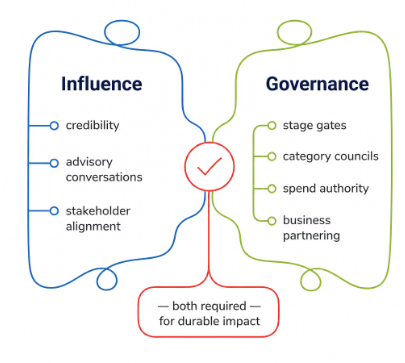
Influence without governance, however, becomes charm.
The CPO who relies on goodwill to be invited early into decisions is one leadership change away from being bypassed again. Durable stakeholder engagement is built into governance: stage gates, category councils, spend authority frameworks, and business partnering models that make procurement involvement structural rather than discretionary. Influence is the capability. Governance is what makes it stick.
4. Digital judgment
The temptation when defining digital capability is to reach for technical fluency: data literacy, AI prompt engineering, system configuration. These are useful at the practitioner level. At the CPO level, the requirement is different.
McKinsey’s research on best-in-class procurement organisations finds that 22 percent of employees in leading functions work in analytics roles. The CPO does not need to be one of them. The CPO needs to be able to lead them: to evaluate which technology investments are worth making, to set direction for AI adoption without delegating the judgment to vendors, to attract and retain analytical talent in a market where procurement is competing with finance, consulting, and technology for the same people.
Digital judgment means knowing which tools solve real problems and which ones create the appearance of progress. It means being able to have a substantive conversation with a CTO or CDO about data architecture without losing the thread. It means understanding that the biggest risk in procurement technology is not choosing the wrong system. It is choosing any system without the process discipline and talent to use it.
At the CPO level, digital capability is fundamentally an operating-model judgment: what should be automated, what should stay human, what data architecture is needed, where AI poses legal or commercial risk, how workflows change, and whether the function has the process discipline to benefit from technology at all. Deloitte’s 2025 survey finds digital leaders in procurement reporting stronger outcomes across savings, stakeholder satisfaction, supplier performance, and risk management. The gap is not technical fluency. It is whether the CPO can set direction for digital investment and hold accountability for the operating model it requires.
5. Risk and resilience
Supplier risk at enterprise scale is a different problem from supplier risk at category scale. At category scale, the question is whether a specific supplier can deliver. At enterprise scale, the question is whether the organisation understands its third-party dependencies well enough to make strategic decisions about them.
The specific capability is not risk awareness. It is risk translation. The CPO briefing the board on supply chain resilience needs to map third-party dependency, quantify exposure in financial terms, frame scenario-based sourcing decisions, build the investment case for resilience measures, and make risk trade-offs legible to people who are deciding how to allocate capital. That is a different skill from maintaining a category risk register.
Recent disruptions, supply chain shocks, geopolitical shifts, ESG reporting obligations, have made this visible. But the capability requirement is not new. The CPOs who navigated those events better had already built the risk translation capability before the events happened. That is the pattern worth noting: organisational standing to get remediation funded before the crisis materialises, not after it.
6. People leadership and pipeline
A procurement function at enterprise scale does not run on the CPO’s capability. It runs on the team. And the team the CPO needs to build now is different from the team that got the function to where it is.
The CPO is no longer building a sourcing team. They are building a hybrid function: category experts, commercial advisors, data analysts, supplier-risk specialists, sustainability specialists, and AI-enabled process owners. Those roles require different hiring profiles, different development pathways, and different management. In a thin talent market, procurement is competing with finance, consulting, and technology for the analytical and advisory capability it needs. That is not an HR problem. It is a strategic one.
The CPO who treats people development as an HR function rather than a strategic priority will consistently compensate for team capability gaps personally. That is a good description of how CPOs burn out. Building succession, and building it for the function the CPO needs in three years, not the one they inherited, is a capability in itself.
Where the competency gaps cluster
Most CPOs have built genuine strength in category-level strategy and commercial skill at the deal level. These are the capabilities that got them the role.
The gaps tend to cluster elsewhere.
Deloitte’s 2025 global CPO survey highlights digital capability and consulting skills, advisory influence, commercial translation, stakeholder alignment, as prominent gaps in procurement leadership globally.
Both map directly to the model above.
Enterprise finance fluency and governance design also tend to be underdeveloped: most CPOs are strong on savings, weaker on benefits architecture and decision-rights design. Digital judgment is not the same as digital proficiency, and most CPO development programmes build neither.
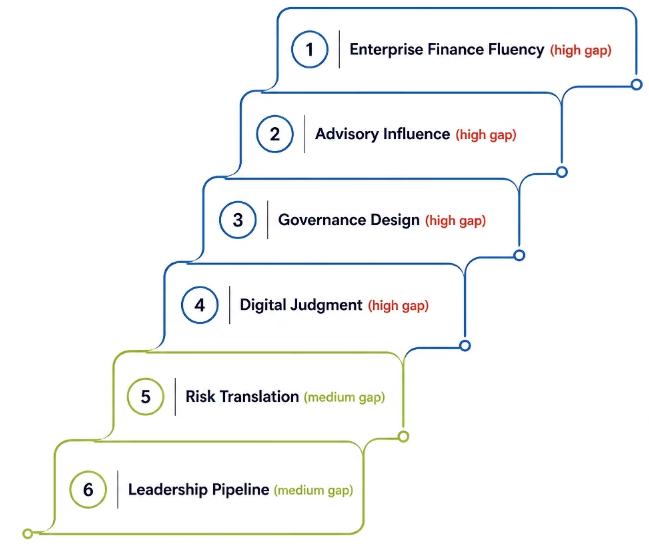
Reference: https://www.deloitte.com/us/en/alliances/articles/deloitte-coupa-future-of-procurement.html
They do not arrive with seniority. They have to be developed.
The CIPS competency framework describes the progression from Leading to Influencing level as a qualitative shift rather than a seniority progression.
The behaviours required to influence at enterprise level, building coalitions, shaping decisions that sit outside procurement’s formal authority, operating credibly in commercial and financial conversations at board level, are categorically different from the behaviours required to lead a high-performing category team. One is a more advanced version of the other in only the loosest sense.
Why this map matters
There is a practical reason to name these procurement capabilities precisely.
Development investment is finite. A CPO programme that builds category management depth for people who already have it is not a bad programme. It is an expensive way to stay still.
The right development question is not “how do we make our procurement leaders better at procurement?” It is “which specific capabilities are limiting our CPO’s ability to operate effectively at enterprise scale, and what would it take to close those gaps?
Those are different questions, and they require different answers. The gaps worth assessing are enterprise finance fluency, advisory influence, governance design, digital operating judgment, risk translation, and leadership pipeline depth. Not all CPOs have the same gap profile. The investment should go where the gap actually is.
Next in this series: Why Most Procurement Leadership Development Doesn’t Work, and What the Exceptions Have in Common
If your function has the technical depth but the CPO is doing the thinking the team should be doing, that is a capability design problem. Talk to Comprara about a capability assessment.
For structured development aligned with this capability model, the Academy of Procurement’s CPO leadership programme addresses each domain in a procurement-specific format.