

A supplier consolidation across four business units. The analysis is rigorous: $12 million in addressable savings, reduced supplier complexity, stronger contract terms, better risk coverage. The business case clears the steering committee.
Then the friction starts.
IT flags integration risk with existing platforms.
Operations wants continuity guarantees the transition timeline can’t accommodate.
Legal introduces renegotiation guardrails the preferred supplier hasn’t agreed to.
ESG requires traceability clauses that will take months to verify.
Finance challenges the benefit timing, they want it in this financial year, not spread across three.
And then the stakeholder nobody planned for, Cyber, Corporate Affairs, or a regional frontline leader, effectively vetoes the program through delay, exception requests, or workaround behaviour.
The initiative doesn’t fail loudly.
It bleeds out through friction, rework, and reputational anxiety.
Eighteen months later, three of the four business units remain on legacy arrangements. Procurement is blamed for not “managing stakeholders well enough.”
That diagnosis is comfortable.
It’s also wrong.
This isn’t a stakeholder failure.
It’s a system design failure.
In complex organisations, stakeholders respond to the system you’ve built—governance, incentives, sequencing, and decision rights. When that system makes engagement slow, uncertain, or politically risky, bypass is the rational outcome.
The Procurement Reality: Why Stakeholder Influence Is Harder Now
If you lead procurement in a complex enterprise today, the environment you operate in is materially different from even a few years ago.
Cross-functional coupling is tighter than ever
A major sourcing decision no longer sits inside one function. It now sits across many.
Finance, Legal, IT, Operations, Risk, ESG, Security, and Communications routinely share ownership of procurement outcomes. Each of those groups carries legitimate concerns, distinct success metrics, and different risk tolerances.
In that environment, the idea that procurement can run a process and “consult” stakeholders near the end was always optimistic.
Today it is structurally unrealistic.
By the time a sourcing decision is formed, multiple functions already have a stake in its shape.
External stakeholders now shape internal decisions
Procurement decisions are no longer bounded by the organisation’s walls.
Regulators, strategic suppliers, alliance partners, and public stakeholders increasingly influence what is commercially viable.
Recent regulatory developments illustrate the shift. Instruments such as the EU AI Act and the Digital Operational Resilience Act have pushed third-party technology risk into board-level territory. Even organisations outside those jurisdictions are seeing the same directional pressure: procurement decisions involving technology, data, or critical providers now carry governance implications from the outset.
The practical consequence is simple. Every major sourcing decision has external touchpoints. Each one introduces additional stakeholders internally who are accountable for managing that exposure.
Stakeholder capability isn’t a soft skill.
It’s an operating requirement.
Feedback loops have compressed
The distance between decision and consequence has shortened dramatically.
A cyber incident, a supplier failure, or a disruption amplified through social channels can surface the implications of a procurement decision in days rather than months.
Speed changes behaviour.
When consequences appear faster, more stakeholders want visibility earlier. Scrutiny moves upstream. Decisions that once attracted attention after implementation now attract attention during design.
Faster feedback doesn’t just increase risk. It expands participation.
The definition of procurement success has broadened
Savings alone no longer defines a good procurement outcome.
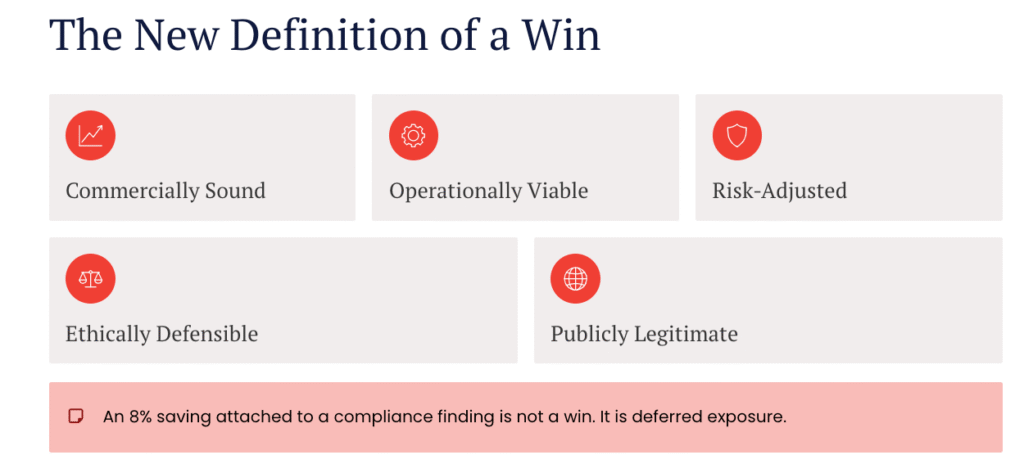
A decision is now judged across multiple dimensions at once: commercial value, operational continuity, risk posture, defensibility, and public legitimacy.
This changes how outcomes are evaluated. An 8 percent saving attached to a compliance breach or reputational issue will not be remembered as a cost win. It will be treated as a failure that happened to contain a temporary saving.
That shift matters because it redraws the success criteria stakeholders use when deciding whether to support a procurement initiative.
What “Complex” Actually Means for a Procurement
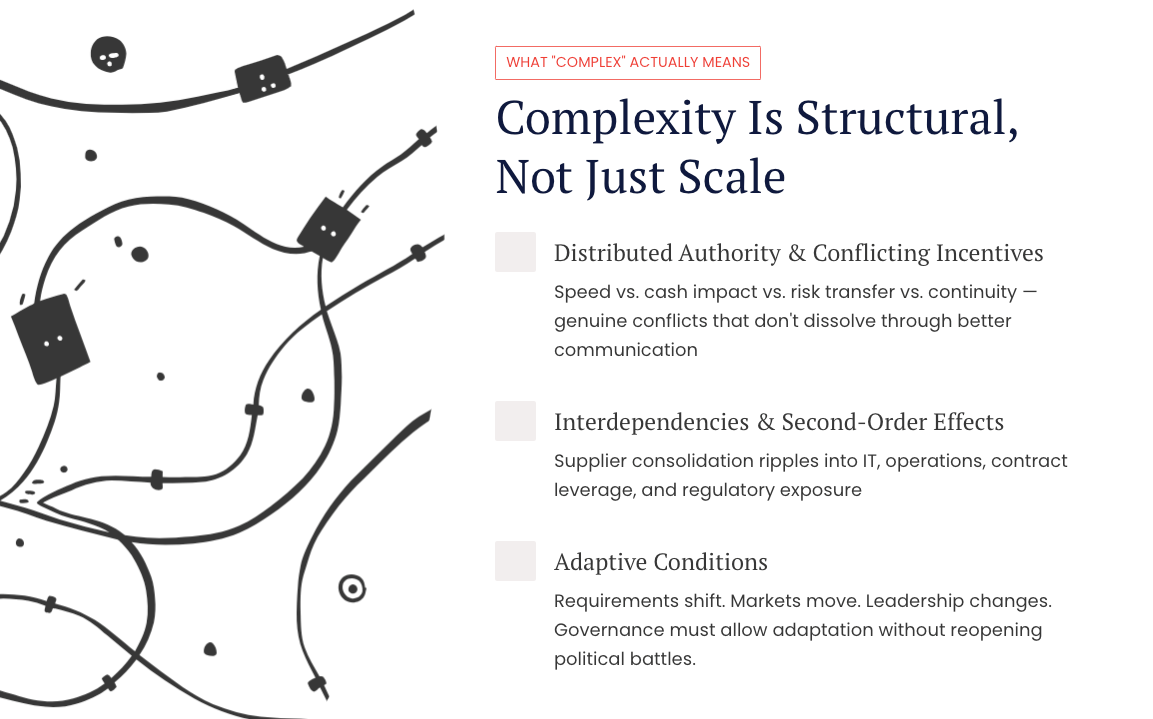
Complexity is not size. It is structural.
In procurement terms, complexity has three defining characteristics:
1. Distributed Authority and Conflicting Incentives
The business unit wants speed.
Finance wants cash impact.
Legal wants risk transfer.
Operations wants continuity.
ESG wants traceability.
These conflicts persist because they reflect genuine accountability structures. They don’t dissolve through better communication.
2. Interdependencies and Second-Order Effects
Consolidating a supplier affects:
- IT integration cost
- Operational transition risk
- Contract leverage in adjacent categories
- Regulatory exposure
A sourcing decision that models only first-order effects will be blindsided by stakeholders responsible for second- and third-order consequences.
3. Adaptive, Shifting Conditions
Requirements evolve.
Markets move.
Leadership changes.
External risks emerge.
What was aligned at business case stage may not survive contact with implementation reality.
In stable systems, governance enforces compliance.
In adaptive systems, governance must enable adjustment without triggering political renegotiation.
That is where many procurement models break.
Cross-functional sourcing
environments behave more like
political systems than workflows.
Why Traditional Stakeholder Management Fails in Complex Procurement
Most procurement functions treat stakeholder engagement as a project task:
- Map stakeholders
- Brief them
- Secure sign-off
That works when decisions are bounded and stakeholders are stable.
It fails when authority is distributed, incentives conflict, and consequences are interconnected.
In complex environments, alignment achieved once does not persist automatically.
So teams compensate.
They rely on relationships.
They negotiate informally.
They escalate through influence.
It works, until the individual holding the network together leaves, or the stakes increase beyond informal authority.
If your strongest procurement leaderbr left tomorrow, would stakeholder
alignment still hold?
Three Structural Failures That Masquerade as Relationship Problems
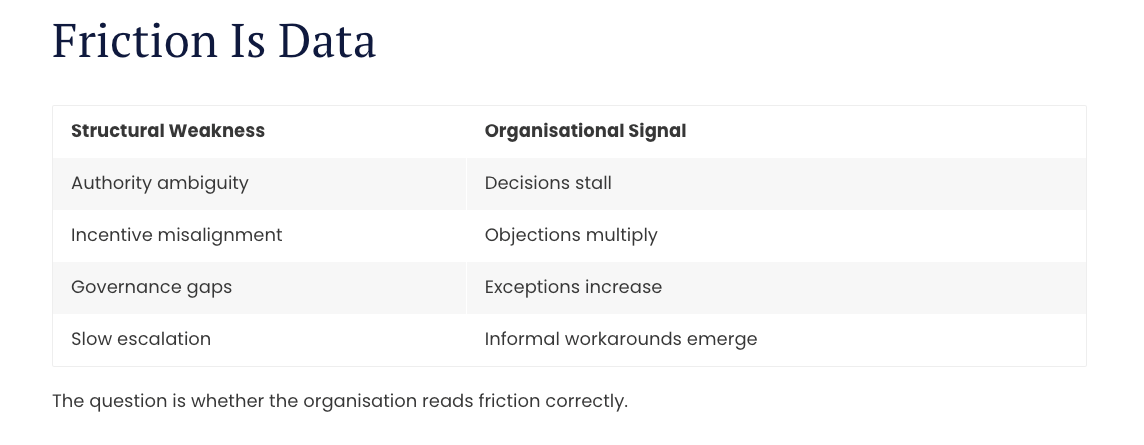
In large organisations, most stakeholder breakdowns are not capability failures. They are governance design failures.
1. Decision Rights That Exist on Paper but Not in Practice
- Category councils that rarely meet
- Delegated authority frameworks routinely bypassed
- Escalation committees that convene quarterly
When governance is performative, rational actors work around it.
That behaviour is not political sabotage. It is system optimisation.
2. Value Cases Framed in Procurement Language
Savings percentages.
Compliance metrics.
Supplier rationalisation targets.
These matter inside the function.
They mean little to:
- An operations leader accountable for service uptime
- A CFO accountable for cash flow timing
- A risk committee accountable for residual exposure
If the value narrative hasn’t been translated into stakeholder-specific accountability language before objections arise, procurement has framed a debate it cannot win.
3. Absence of Stage-Gate Governance for Major Procurements
Without defined review points, stakeholders intervene late, when change is expensive and positions are entrenched.
Effective stage-gate governance:
- Surfaces objections early
- Documents trade-offs
- Clarifies legitimacy
- Protects procurement from retrospective blame
Without it, every downstream issue becomes a referendum on the original decision.
Designing for Procurement Influence: What Structural Authority Looks Like
Designing for influence isn’t about adding another forum.
It’s about making the right behaviours inevitable.
If engaging procurement is the easiest way to get a decision made, the business will do it. If it’s slower than bypassing you, it won’t.
Clear, enforced decision rights
Start with the basics.
Who decides, who advises, who has veto, and what evidence is required.
Not as a RACI that lives in SharePoint, but as rules that are actually applied when a decision is contested.
The test is practical: when a business unit wants to run ahead, do your decision rights hold under pressure, or do they dissolve into “we’ll sort it out offline”?
Governance that matches business tempo
Governance fails when it moves slower than the business cycle it’s meant to control.
If the operating model can’t make a decision inside the timeframe the organisation needs, people will decide without it. That isn’t bad behaviour. It’s the system responding rationally.
High-authority functions don’t win by insisting on process. They win by designing governance that can move at enterprise speed without compromising rigour.
Stakeholder-specific value narratives
One of procurement’s recurring mistakes is treating the value case as a universal language.
It isn’t.
The same decision needs to be framed differently depending on what each stakeholder is accountable for.
A board wants to understand risk and defensibility.
A business leader wants to understand service continuity and speed.
Finance wants the cash timing. Legal wants where liability ends up after transition.
If procurement can’t speak in those terms before objections are raised, it ends up arguing from its own metrics, which is rarely the metric that decides the outcome.
Steering forums are common. Decision-making forums are rare.
If a steering group cannot resolve a contested trade-off quickly, and escalate when it can’t, it becomes a place where people restate positions and defer responsibility. That’s why decisions “bleed out” rather than fail. Nobody has to say no if they can just slow it down.
Authority needs to be explicit, time-bound, and supported by an escalation path that actually functions.
Accountability for stakeholder orchestration
In complex procurements, stakeholder work is not a kickoff activity. It’s continuous sensing: who has power, what they care about, what has changed, and where friction is building.
There are only a few disciplines that matter here. Keep them simple and operational:
- Maintain an active view of stakeholder power and shifting salience
- Surface interdependencies early, before they appear as late vetoes
- Watch for “hidden” stakeholders who only emerge when implementation begins
- Treat influence networks as part of risk management, not relationship management
This is not soft work. It is governance work. And it belongs inside role expectations and performance measures, not as an optional skill some people happen to have.
The Procurement Operating Model Design Test
Here is the simplest diagnostic:
If you removed every personal relationship your procurement team has built, every coffee, every informal escalation, every favour, would your governance and operating model still give procurement a seat at the table?
If the answer is no, you don’t have a stakeholder management problem.
You have an authority design problem.
Relationships matter.
But they are not load-bearing
infrastructure.
If This Describes Your Procurement Operating Reality
Most CPOs can sense when their procurement function is working harder than its operating model allows.
The harder question is where the structural constraint actually sits.
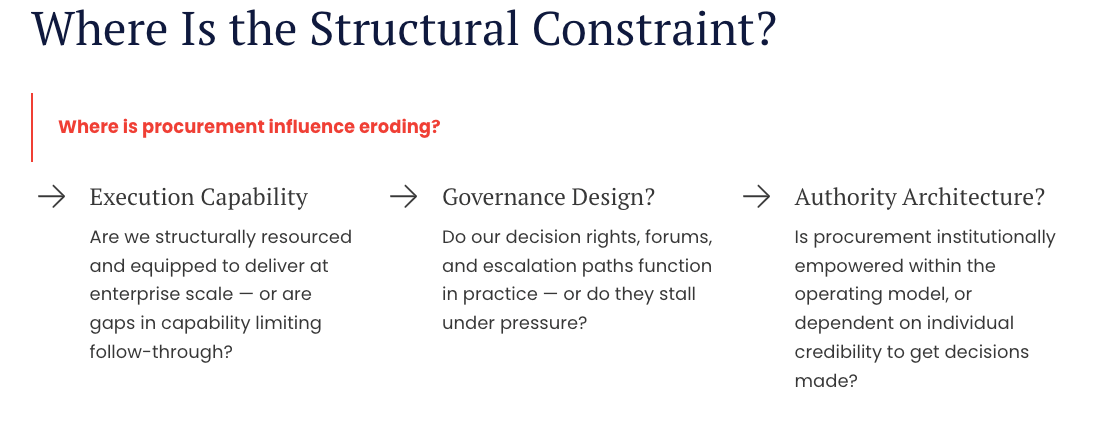
For some organisations it’s execution capability. For others it’s governance design. And in many cases, it’s authority architecture, the operating model itself limiting influence before the work even begins.
Diagnosing that difference matters. Because each constraint requires a different intervention. Strengthening capability won’t fix a governance bottleneck. Redesigning governance won’t help if the issue is how procurement insight is translated for executives. (See How Procurement Leaders Use Data to Shape Strategy for how narrative capability directly affects influence.)
Comprara works with enterprise and government procurement leaders to diagnose whether influence limitations stem from capability gaps, governance design, or operating-model misalignment, and to redesign the system accordingly.
If you want an external perspective on whether your procurement authority architecture is enabling or constraining performance, contact Comprara for a confidential discussion.
Part 1 of the Series: Power, Design, and Trust
This article opens a broader conversation.
Procurement influence in complex organisations is not primarily a behavioural issue. It is an architectural one.
In the coming articles, we will examine:
- Why accommodation erodes authority
- How benchmarking creates executive alignment
- Why governance redesign outperforms training
- How high-authority procurement models are structured