
Procurement has changed dramatically since the 1980s, but many of its core commercial problems have not. Cost still matters. Price is not total cost. Market knowledge creates leverage. Supplier choices create dependencies. Negotiated value can disappear after award. Procurement still wrestles with influence, capability, operating-model design and the promise of technology.
I’ve been feeling a bit nostalgic lately.
Maybe it was the Bon Jovi and AC/DC coming out of the man cave. Maybe it was thinking back to my early days at Holden, where I first learned procurement and started to understand what the job actually involved.
Either way, it got me thinking about how much procurement likes to talk about how much it has changed.
And it has.
The systems are different and the data is better. The mandate is broader. Supply markets are more connected. Technology sits inside far more categories, and the risks attached to external suppliers have multiplied.
But go back forty years and many of the questions are still there.
In 1980, Robert Spekman and Ronald Hill published Strategy for Effective Procurement in the 1980s. David Farmer followed in 1981 with Seeking Strategic Involvement. By 1988, Reck and Long were writing about Purchasing: A Competitive Weapon. In 1990, Pearson and Gritzmacher were arguing for Integrating Purchasing into Strategic Management.
Different decade. Different language. Very familiar ambitions.
How do we understand the real economics of a decision? How do we know when a supplier has too much leverage? When should procurement become involved? Which suppliers deserve attention? Where should authority sit? How do we turn an agreed commercial outcome into an actual financial result?
Those were procurement questions then. They are procurement questions now.
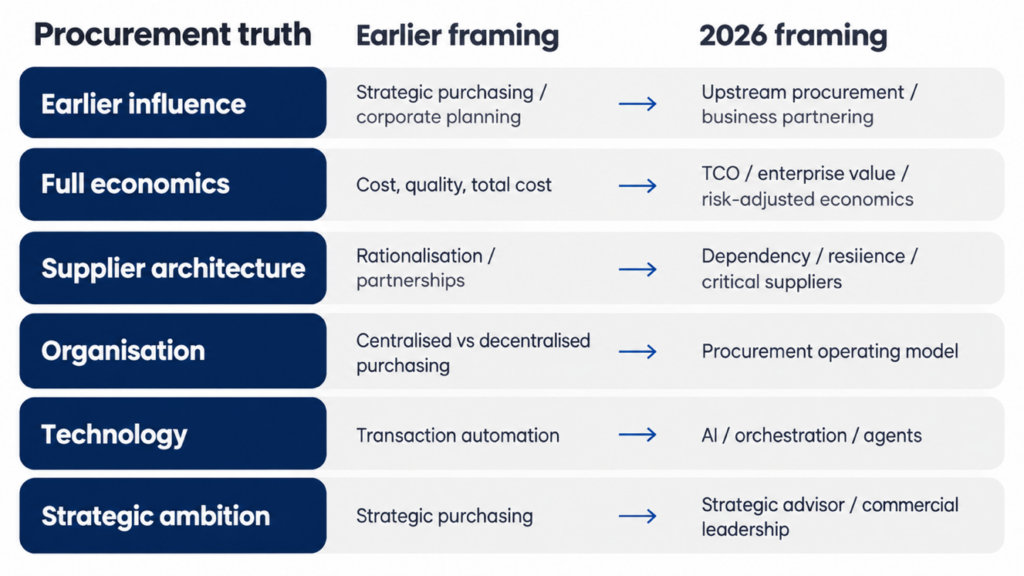
Note. These are lineages rather than exact equivalents: today’s problems are often broader and technically more complex.
Still, the continuity matters because much of the underlying commercial work proved harder to replace than the terminology around it.
1. Cost still matters
Procurement has spent decades explaining that it delivers more than savings.
It does. That never made cost optional.
Every procurement decision is an economic decision. Procurement exists to acquire something the organisation needs from outside itself, using resources that are always finite.
The objective may be resilience. It may be innovation, sustainability, speed, growth or access to capability the organisation does not have internally.
But none of those outcomes is free.
Someone still has to decide what the organisation is willing to pay, what trade-offs it is prepared to make and whether the outcome is worth the resources committed to it.
That is why cost has survived every attempt to redefine procurement as something broader than savings.
And procurement should be broader than savings. A cheaper supplier can create more risk. A more expensive option may reduce downtime, improve flexibility or create greater value elsewhere in the business. But that does not remove cost from the decision. It makes the economic judgement more important.
Deloitte’s 2025 Global CPO Survey found 72% of respondents prioritising margin improvement through cost reduction, ahead of operational efficiency at 68% and digital transformation and GenAI at 67%. The figures are not directly comparable with academic research from the 1980s, but the persistence is telling.
A CPO may now be responsible for supply chain resilience, innovation, sustainability, risk and growth.
Eventually, the organisation still has to ask: What are we getting, what are we giving up, and is the trade worth it?
2. The cheapest price has never necessarily meant the lowest cost.
Procurement has always had to look beyond the number on the quote.
A lower purchase price can be offset by poorer quality, higher maintenance, greater operating cost, more waste, additional support or a shorter useful life. That basic commercial problem is not new.
What changed was the way procurement learned to describe and measure it. As organisations bought more complex goods, services and technology, the costs sitting around the initial purchase became harder to ignore. Implementation, licensing, maintenance, transition, support and eventual exit could materially change the economics of the decision.
Total cost of ownership gave procurement a more formal way to account for those consequences.
Lisa Ellram’s early-1990s work helped formalise TCO as an approach to looking beyond purchase price to the wider cost of doing business with a supplier. Ellram and Siferd also noted that purchasing literature had considered costs beyond price much earlier.
So TCO was not a new commercial truth it was just a more systematic way of applying an old one.
Total cost of ownership (TCO) estimates the full economic cost of an acquisition across its life, including acquisition, operating, maintenance and end-of-life costs.
In other words: a cheap quote can still produce an expensive commercial outcome.
3. Knowing the market creates leverage
Procurement cannot negotiate effectively from a market position it does not understand.
In 1983, Peter Kraljic argued that purchasing strategy had to respond to supply-market complexity, scarcity, political disruption, competition and changes in supplier power. The matrix became famous. An important idea sat underneath it: purchasing decisions should respond to the structure of the market.
Not every category should be treated the same because not every market behaves the same.
Today the tools are far better. Procurement can access commodity data, supplier intelligence, financial information, should-cost models and AI-assisted market research.
But better information has not changed the questions.
What alternatives exist? Who has capacity? Where does the supplier have leverage? How difficult is switching? What is happening to the economics underneath the quoted price?
Technology can help us answer those questions faster. It cannot make them irrelevant.
4. Negotiation still matters
The negotiator may change. The need to negotiate does not.
Why does negotiation still matter?
Because buyers and suppliers still want different things.
One wants a lower price. The other wants a higher one. One wants flexibility. The other wants commitment. One wants risk transferred. The other wants to be paid for taking it.
Technology does not remove those competing interests.
It changes who, or what, can resolve them.
Analytics can strengthen the fact base. AI can prepare scenarios and identify possible trades. Should-cost models can expose assumptions. And increasingly, negotiation agents can do more than prepare the human negotiator. They can negotiate themselves.
That raises a more interesting question.
Does negotiation still need a human?
For every negotiation, probably not.
Much of commercial negotiation follows principles procurement has understood for decades: know your alternatives, understand the other party’s interests, establish boundaries, trade rather than concede, protect what matters most and know when to walk away.
Those principles can increasingly be expressed as data, rules, objectives and guardrails. An AI agent can apply them repeatedly across negotiations that procurement teams may never have had the capacity to conduct manually.
In structured negotiations, that is already happening.
The harder question is where the rules stop being enough.
A strategic supplier negotiation may involve a relationship the organisation expects to rely on for years. The parties may be dealing with incomplete information, novel risks, internal politics or consequences that are difficult to express as an optimisation problem. Sometimes the negotiation itself changes what each side understands, values or is willing to do.
That is where human judgement may continue to matter most.
But the enduring procurement truth is not that two people must sit across a table.
It is that commercial interests still have to be reconciled.
The negotiator may increasingly be human, machine or both.
The negotiation remains.
5. Negotiated procurement savings are not necessarily realised savings
Procurement can negotiate a better commercial outcome without the organisation ever receiving the full economic benefit.
This is not a new procurement problem.
For decades, buyers have been able to negotiate a lower price only to discover that the saving did not fully appear in the organisation’s results.
Sometimes the new price never reached the purchase order or invoice. Sometimes employees continued buying from the old supplier. Sometimes the promised volume never moved. Sometimes demand increased. And sometimes Procurement and Finance simply disagreed about what the original cost would have been.
The problem was the distance between the deal that was negotiated and what the organisation actually did afterwards. That distance still exists.
What has changed is how much can now happen inside it.
Today’s commercial models may include subscriptions, consumption charges, implementation costs, indexation, rebates, contract variations and demand assumptions. A negotiated rate may be excellent while the organisation still spends more because usage grows. A sourcing saving may disappear because implementation costs rise. A favourable contract may produce little benefit if users do not adopt it.
McKinsey’s 2025 analysis of 43 enterprise transformation programs found the average procurement savings pipeline lost one-third of its estimated value during planning and another 20% during execution. The finding comes from transformation programs and should not be treated as a benchmark for every procurement function.
But the mechanism is familiar.
The strategic sourcing process creates the possibility of value. What happens afterwards determines how much of that value becomes real.
Rates have to reach purchase orders. Demand has to move. Stakeholders have to change behaviour. Contracts have to be managed. Finance has to be able to see the result.
The old problem was leakage between agreement and execution.
So, today’s problem is the same, except there are now more places for the value to leak.
6. Fewer suppliers are not automatically better
Strategic sourcing taught procurement to use the supply base more deliberately. The harder lesson was that concentrating leverage can also concentrate risk.
One of the important changes in procurement from the 1980s into the 1990s was the rise of strategic sourcing.
Purchasing was becoming less about individual transactions and more about looking across organisational spend, supply markets and categories to decide how the organisation should buy.
That changed the supplier question.
Instead of asking only, “Who should we buy this from?”, procurement could ask, “Why are we buying the same thing from so many suppliers in the first place?”
Supplier rationalisation became one of the answers.
If an organisation spread similar spend across too many suppliers, it could dilute its buying power, duplicate administration and make supplier performance harder to manage. Consolidating that spend could create leverage, reduce complexity and give important suppliers enough volume to invest in the relationship.
The logic was sound.
But leverage has a consequence.
The more spend, capability or knowledge an organisation concentrates with fewer suppliers, the more important those suppliers can become to the organisation.
What looked like efficiency could also create dependence.
And that trade-off has become more consequential as suppliers have moved beyond providing discrete goods into running technology platforms, outsourced processes, infrastructure and other capabilities that can be difficult to replace.
So yes, the strategic sourcing question has evolved from “where can we consolidate spend to create more leverage?” to also “where can we afford to concentrate dependency?”.
A fragmented supply base may still waste leverage.
An aggressively consolidated one may still leave the organisation with high switching costs, limited fallback capacity or too much reliance on one supplier.
The original strategic sourcing principle remains useful: design the supply base deliberately.
What changed is what procurement now has to consider when it does.
There has never been a universally correct supplier count.
7. More suppliers are not automatically safer
Procurement learned that diversification is only useful when the alternatives are genuinely independent.
For a long time, diversification looked relatively simple.
If relying on one supplier created risk, the obvious answer was to have more than one.
And in many categories, that was sensible.
Multiple suppliers could create competition, preserve fallback capacity and reduce the organisation’s exposure if one supplier failed.
But as supply chains became more global, layered and technology-dependent, a problem became harder to ignore.
Two suppliers were not always two sources of supply.
Four contracted suppliers might all depend on the same manufacturer. They might use the same logistics hub, cloud platform, critical component, geography or upstream provider.
On paper, the organisation had diversified while in practice, the dependency had simply moved further down the chain. That is what changed.
Earlier supplier diversification focused more heavily on the number of direct suppliers available to the buyer. Today’s resilience work increasingly asks whether those suppliers are genuinely independent once the wider supply network is considered.
So while supplier count is visible, dependency is not always visible. And that is why more suppliers are not automatically safer.
8. Not every supplier deserves a strategic relationship
Calling a supplier “strategic” does not make the relationship strategic.
Lisa Ellram was studying supplier selection for strategic partnerships in 1990 and publishing guidance on purchasing partnerships in 1991. That work treated partnership as something appropriate to particular relationships, not the default model for every vendor.
That selectivity still matters.
Senior attention is scarce. Strategic supplier management earns its keep when the relationship can materially change performance, economics, responsiveness, innovation or risk.
If it cannot, more governance may simply mean more meetings.
9. Contract signature is not the end of the commercial job
Procurement learned how to source and negotiate more strategically. Then it had to confront what happened after the deal was signed.
For much of procurement’s development, contract award could feel like the end of the job.
The market had been tested. The supplier had been selected. The terms had been negotiated. The contract had been signed. Done? Done!
But, of course we know that the value in a contract does not arrive at signature. It arrives over time.
That became more important as procurement developed disciplines such as strategic sourcing and category management. Procurement became better at identifying opportunities, shaping supply strategies and negotiating stronger commercial outcomes.
But a better deal on paper created another question. Who makes sure the organisation actually receives it?
That is where contract management became a more important commercial discipline.
Prices have to be applied correctly. Obligations have to be met. Supplier performance has to be managed. Variations have to be controlled. Benefits have to be tracked. Problems have to be addressed before they become expensive.
And the longer and more complex the contract, the more opportunity there is for the economics to change after award.
World Commerce & Contracting and Deloitte’s 2023 research across 1,236 organisations estimated average contract value erosion at 8.6%. The figure covers the contracting lifecycle, so it should not be described as procurement savings leakage. It points to a broader problem: commercial value continues to move long after signature.
The principle itself is not new; a procurement contract has always needed to be managed.
What changed was the scale and complexity of what organisations began asking contracts to carry. Outsourcing, managed services, technology platforms and long-term supplier relationships made post-award performance more commercially consequential.
That pushed procurement beyond sourcing the agreement and towards managing the relationship, the obligations and the economics around it.
In Procurement, we are still figuring out exactly where that responsibility should sit.
A 2025 NSW Audit Office report found inconsistent supplier management among 17 sampled agencies, including eight without a structured SRM approach and four without mandatory formal contract closure or evaluation.
So the problem has not disappeared as the discipline matured.
In some organisations, sourcing remains separated from contract management. In others, category managers, contract managers, operational teams and supplier relationship managers share different parts of the responsibility.
The organisational model varies. The principle does not.
Contract award creates potential value. What happens after signature determines how much of it survives. The sourcing team may have moved on. The economics have not.
10. Procurement still wants to be involved earlier
Earlier procurement involvement still matters because there is more room to influence specification, market approach, cost and risk before the requirement hardens.
Procurement has been asking to get involved earlier for a very long time.
Farmer was writing about “strategic involvement” in 1981. Reck and Long’s 1988 research argued that simply doing purchasing well did not make the function a strategic contributor. Pearson and Gritzmacher made the case for integrating purchasing into strategic management in 1990.
Today we call it upstream involvement, early engagement or business partnering.
Different words. Same ambition.
But after forty-five years, “the business needs to involve procurement earlier” cannot be the whole diagnosis.
The business also needs a reason to involve procurement earlier , because earlier access, by itself, changes nothing.
Procurement can be invited into the room before the requirement is fixed and still have little effect on the decision. The value comes from what procurement can see, challenge or improve while choices are still open.
That leads to a second, older problem. Being present is not the same as being influential.
11. Procurement authority does not guarantee procurement influence
Formal authority can require procurement involvement. It cannot make the business trust procurement’s judgement.
Procurement has long relied on policies, thresholds and approval gates to create a place in the decision. A policy can require a stakeholder to involve procurement but it cannot make them believe procurement will improve the outcome.
That matters because the most valuable procurement contribution often depends on influence before there is anything to approve.
Influence comes from understanding the market, seeing consequences others have missed, challenging assumptions and helping the business make a better commercial decision.
Of course, formal authority still matters. Large organisations need controls, decision rights and governance. But credibility determines whether anyone listens once it gets there.
Procurement has spent decades trying to become more strategic.
That ambition has always depended less on the right to participate than on the ability to change the decision.
12. Procurement never has quite the capability its ambition requires
Procurement’s ambition has repeatedly moved faster than the function’s ability to build all the capabilities needed to deliver it.
Every generation of procurement seems to imagine a bigger role for the function.
Then it discovers it needs different skills to perform it.
Strategic thinking and negotiation were prominent as purchasing sought a bigger corporate role. Then came category management, supplier management and analytics. Digital fluency followed.
AI literacy is now joining the list.
While the individual capabilities change, the gaps remain.
In Australia, the 2025 APS Agency Survey found that 31 of the 78 agencies reporting critical skills shortages identified procurement and contracting as one of them. Deloitte’s current CPO research likewise lists talent and organisational capability among barriers to value delivery.
We keep expanding what procurement should do.
That makes building procurement capability across the team an ongoing requirement, rather than a one-off response to the latest skills shortage. We then have to build the function capable of doing what we ask of it.
13. Centralised versus decentralised procurement is still a trade-off
There was never one correct place to put every procurement decision.
Kraljic was already making that distinction in 1983. His model did not simply ask whether purchasing should be centralised or decentralised. It assigned different levels of decision authority to different kinds of supply problem. Strategic items were centralised. Bottleneck items were decentralised but centrally coordinated. Leverage items were mainly decentralised. Non-critical items were decentralised.
The principle was differentiation. Put authority where the nature of the commercial problem requires it.
Kraljic described the broader organisational tension as one between purchasing clout and flexibility. Centralisation could strengthen buying power, but it could also become less responsive where plants, technical requirements or national standards differed.
That tension still exists, but the operating model around it has become more sophisticated.
Shared services, GBS, centres of excellence, self-service and automation have allowed organisations to separate transactional execution from commercial decision-making. The question is no longer simply whether “procurement” should sit centrally or locally.
Much of the transactional work can now be standardised or shared.
The harder questions sit elsewhere like: Who owns category strategy? Where should commercial judgement sit? Which decisions benefit from enterprise-wide leverage? When does proximity to the business matter more? Who should manage the supplier relationship?
Today’s federated procurement is therefore less a rejection of Kraljic’s logic than an elaboration of it. The axis has moved somewhat, from clout versus flexibility towards a more granular question of which capabilities and decisions belong at which level.
But the underlying principle is recognisable. Different procurement problems require different placements of authority.
14. Technology keeps moving the boundary between transactional and strategic work
Procurement technology has been removing manual work for decades.
What has shifted is perhaps the work considered worth doing by a person.
For example, early automation attacked the transaction. EDI reduced the manual exchange of purchasing documents. ERP brought purchasing, receiving and financial records into the same system and made controls such as three-way matching far easier to automate.
The underlying question in a three-way match was simple: did we order it, did we receive it, and are we being invoiced for what we agreed?
Instead of checking every clean transaction manually, systems could compare the purchase order, goods receipt and invoice and send the exceptions to someone to resolve.
E-procurement pushed the boundary further. Requisitions, catalogues, approvals and purchase orders moved online. Source-to-pay platforms connected more of the workflow. Analytics reduced the effort required to find patterns in spend and supplier data. Automation took on more repetitive processing.
As transaction processing became easier, procurement was expected to spend more time on category strategy, supplier relationships, risk, business partnering and commercial decisions.
Now AI is pushing against that boundary again.
It can research markets, classify spend, analyse bids, prepare negotiations and increasingly execute parts of the sourcing process itself.
That makes the old promise of “freeing procurement for strategic work” more complicated.
Sure, technology releases capacity, but it also changes what counts as strategic work.
Yesterday, matching an invoice required human attention. Today, the system can handle the clean transaction and send the exception to a person. Tomorrow, AI may resolve many of the exceptions too.
The enduring pattern is not that technology automates the transactional work while humans permanently inherit the strategic work. It is that technology keeps moving the line between the two. And every time that line moves, procurement has to decide what human judgement is still worth keeping.
Procurement did not stand still for forty years. It changed substantially, but many of the same commercial and organisational questions remain.
For a CPO, the useful question is where your own function sits against that history.
Which problems are genuinely new? Which are old problems in new clothes? And which gaps in governance, capability, systems or operating model are still limiting what procurement can contribute?
That is the purpose of Comprara’s Procurement Maturity Assessment. It establishes an evidence-based baseline of the function today, benchmarks it against comparable organisations, and identifies where improvement will make the greatest difference.
Want to know where your procurement function is strong, where it is falling behind, and what to address next? Start with a Procurement Maturity Assessment.
Next: What actually changed in procurement since the 1980s?